
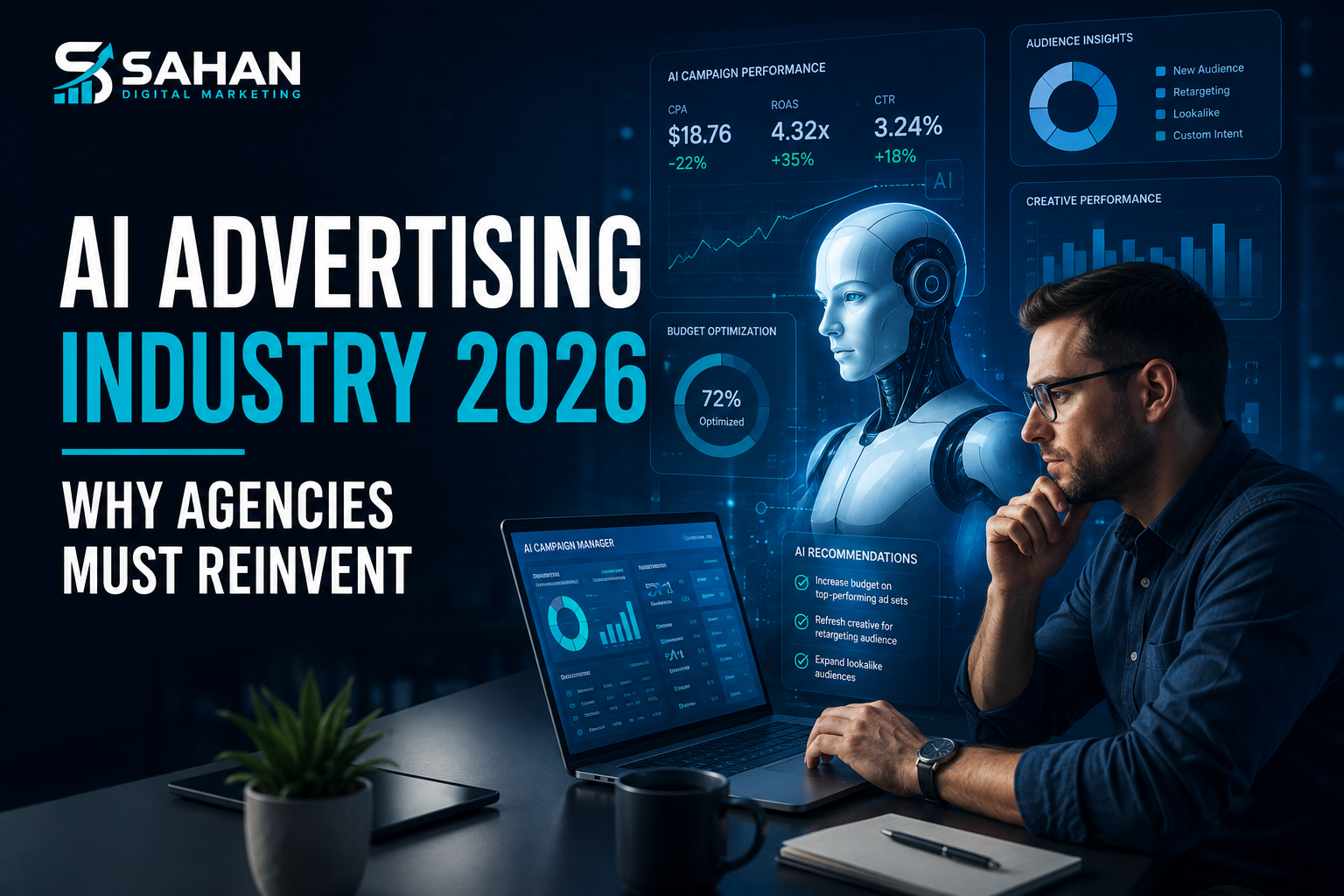
The AI advertising industry shake-up of 2026 is the biggest shift advertising has seen in decades. In 2026, agencies that once seemed untouchable are cutting thousands of jobs, restructuring entire divisions, and racing to prove that AI can do more than replace headcount — it has to actually grow the business.
Here is what is happening, why it matters, and what it means if you run a small business or manage marketing yourself.
The Numbers Behind the AI Advertising Industry Shake-Up
WPP, the world’s largest advertising holding company, is cutting up to 1,000 more jobs by the end of 2026. That is on top of roughly 11,000 roles already eliminated since the start of 2025. Across the industry, agencies including Omnicom and Dentsu have cut a combined 18,000 jobs in the past year and a half.
The driver in almost every case is the same: generative AI now lets brands produce content and manage campaigns at a scale that used to require entire teams of copywriters, designers, and media planners.
Why Agencies Are Struggling to Keep Up
It is not just about job cuts. Agencies are being squeezed from two directions at once:
- Clients are spending less on agency services and using AI tools directly to produce their own content and manage their own campaigns
- Tech platforms are competing directly for agency budgets — companies offer self-service, AI-assisted ad tools that let brands skip the agency altogether
The result is a strange paradox: overall ad spending is still growing, but agency revenue is not keeping pace, because more of that spending is happening in-house or through automated platforms instead of through traditional agency relationships.
What This Means If You Do Your Own Marketing
If you are a small business owner or you handle marketing without a big agency behind you, this shift actually works in your favor. The same AI tools disrupting big agencies are available to you too, often at a fraction of the historical cost of hiring outside help.
- Content production is faster and cheaper — what used to require a copywriter and a designer can now be drafted and refined with AI in a fraction of the time
- Campaign management tools are becoming self-serve — major platforms now offer AI-assisted tools built for businesses without a dedicated media team
- Strategy still matters more than ever — the businesses winning right now are not just using AI tools, they are using them with a clear plan for who they are trying to reach and why. Our digital marketing guide for small businesses explains how to build that foundation.
The Part AI Still Cannot Replace
Even as agencies restructure around AI, industry analysts are clear on one point: tools alone are not a strategy. Agencies that are only adding AI features without changing how they operate are struggling just as much as the ones that have not adopted AI at all.
The differentiator, for agencies and small businesses alike, is not whether you use AI. It is whether you pair it with a clear understanding of your audience, a consistent brand voice, and a real plan for turning attention into results. For businesses ready to automate specific workflows, our guide to AI agents for small business explains where automation helps and where human approval still matters.
The Bottom Line
Advertising is not disappearing — it is being redistributed. Big agencies are cutting costs and restructuring around AI because the old model of billing by the hour for creative and media work no longer matches how fast brands can now move on their own. For small businesses, that same shift means more access to tools that used to be out of reach, and a real opportunity to compete on strategy rather than budget size.