
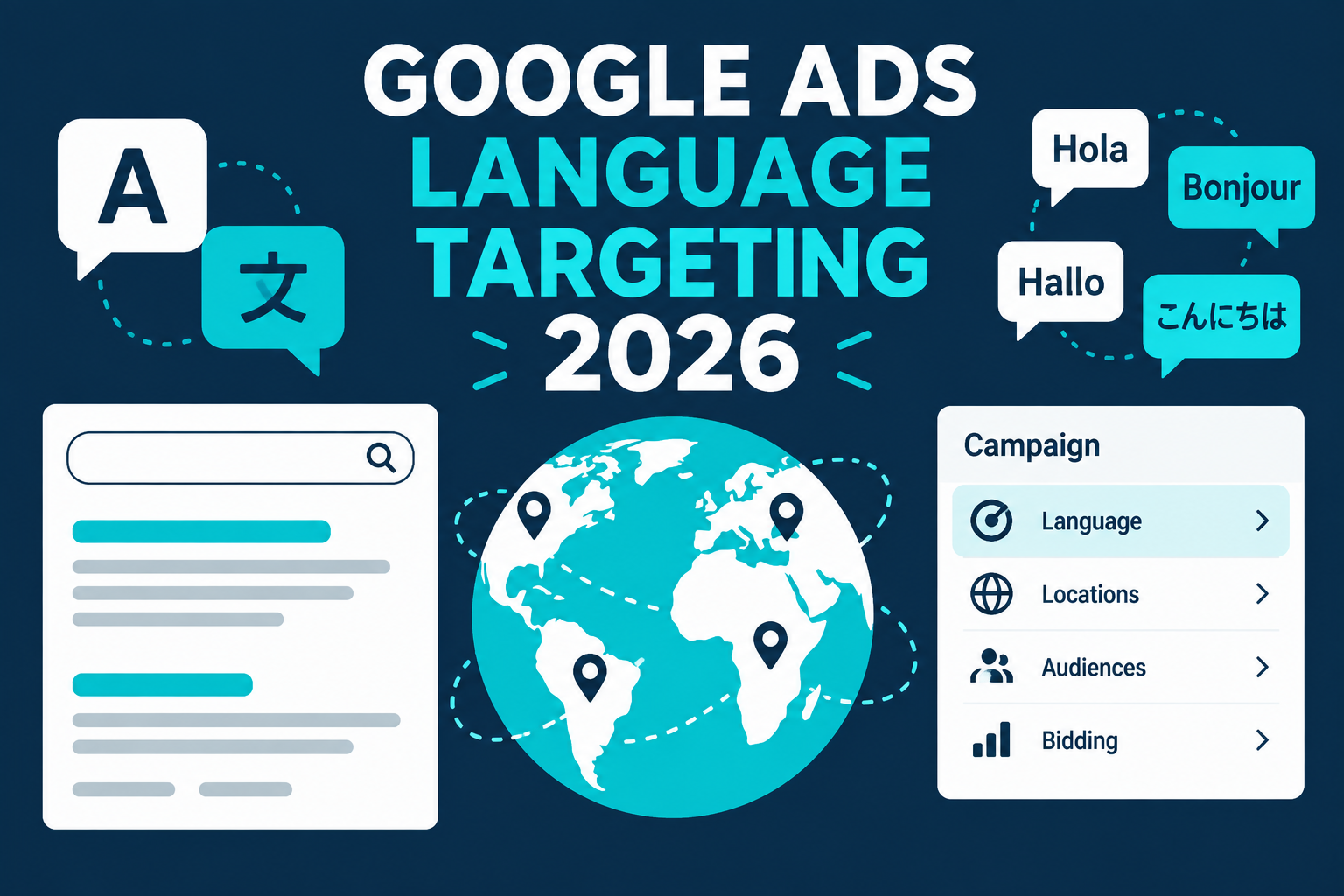
Google Ads language targeting changes in 2026 will affect how Search campaigns and the Search Network portion of Performance Max campaigns match ads to people using different languages. For small businesses advertising across multilingual markets, this is more than a technical update: it may influence which ad creative appears, how campaigns are organised, and how results should be reviewed.
Thank you for reading this post, don't forget to subscribe!Google’s official guidance says that, starting in September 2026, campaign language settings will no longer be required for Search campaigns. Google will instead use signals such as the language of a person’s search terms to determine which ads are relevant. Performance Max will follow this approach on the Search Network, while selected language settings will still apply on YouTube, Display, Discover and Gmail. Shopping ads in Performance Max are not affected by language settings.
This guide explains the change in practical terms and provides a checklist small businesses can use before adjusting their campaigns.
Google Ads Language Targeting Changes 2026: What Is Different?
Historically, advertisers selected one or more languages at campaign level. That setting helped Google decide which users might see the ads. Under the September 2026 change, standard Search campaigns will not depend on a required campaign-language selection in the same way.
The practical idea is simple: when someone searches in Italian, English or another language, Google can place greater emphasis on the language used in the actual query and choose a matching advertisement. This may make multilingual advertising more flexible, but it also makes the quality and organisation of your ad assets more important.
What the Change Does Not Mean
The update does not mean that one generic advertisement should be used in every country. Language and location are different targeting decisions. A business can still waste money if it shows a well-translated advertisement in an area it does not serve.
It also does not remove the need for human review. Automated systems may match language, but they cannot guarantee that a translation reflects local buying habits, cultural expectations or the exact offer available on a landing page.
Why This Matters for Small Businesses
1. Multilingual campaigns may become easier to manage
A business serving customers in several languages may need fewer artificial campaign divisions. However, consolidation is useful only when budgets, locations, offers and conversion goals genuinely belong together.
2. Ad copy must clearly match the searcher
Prepare complete, professionally reviewed headlines and descriptions for every language you serve. Do not rely on literal translation alone. A phrase that sounds persuasive in English may feel unnatural in Italian or another market.
3. Landing-page consistency becomes critical
If the advertisement appears in Italian but opens an English-only page, the experience is confusing and conversions may fall. The headline, offer, price, contact method and call to action should remain consistent from search to advertisement to landing page.
4. Reporting needs to be segmented
Account totals can hide weak performance. Review search terms, locations, landing pages and conversion results by language or market wherever the available reports allow it.
A Practical Google Ads Checklist
- List every language your business can genuinely support.
- Confirm that each market has an appropriate landing page.
- Review Search and Performance Max campaign settings separately.
- Check location targeting and exclusions; do not assume language controls location.
- Audit responsive search-ad headlines and descriptions.
- Remove weak, outdated or incorrectly translated assets.
- Review search-term reports for unexpected languages or irrelevant intent.
- Track qualified leads or sales, not clicks alone.
- Compare performance before and after making changes.
Should You Combine Multilingual Campaigns?
There is no universal answer. Combining campaigns can simplify management and give automation more data. Separate campaigns provide tighter control over budgets, regional offers, schedules and reporting.
My recommendation: keep campaigns separate when different languages also represent different countries, prices, teams or landing pages. Consider consolidation only when the business goal, offer and customer journey are essentially the same.
How AI Max Connects to the Update
Google is also moving more Search functionality into AI Max. Its text-customisation feature can generate additional headlines and descriptions using context from the advertiser’s domain, landing page, existing ads and keywords. Google provides controls to enable or disable this feature and remove individual generated assets.
Small businesses should treat generated copy as a draft that requires monitoring. Check whether each asset is accurate, compliant and consistent with the offer. Automation can improve coverage, but the advertiser remains responsible for the customer experience.
These Google Ads language targeting changes 2026 require advertisers to compare language signals with location, search terms and landing-page performance. Review the campaign after the transition instead of assuming automation will always select the best local message.
Final Takeaway
The Google Ads language targeting changes in 2026 may make multilingual Search advertising more flexible, but they do not replace local knowledge. Strong results still depend on accurate copy, relevant landing pages, correct location targeting and reliable conversion measurement.
If you are improving your wider acquisition plan, read our seven digital marketing strategies for small businesses and our guide to Google Analytics and Search Console.
Editorial note: This article was prepared using official Google Ads documentation and reviewed for practical small-business relevance. Features can vary by campaign type and account. Always confirm current settings inside your own Google Ads account.