
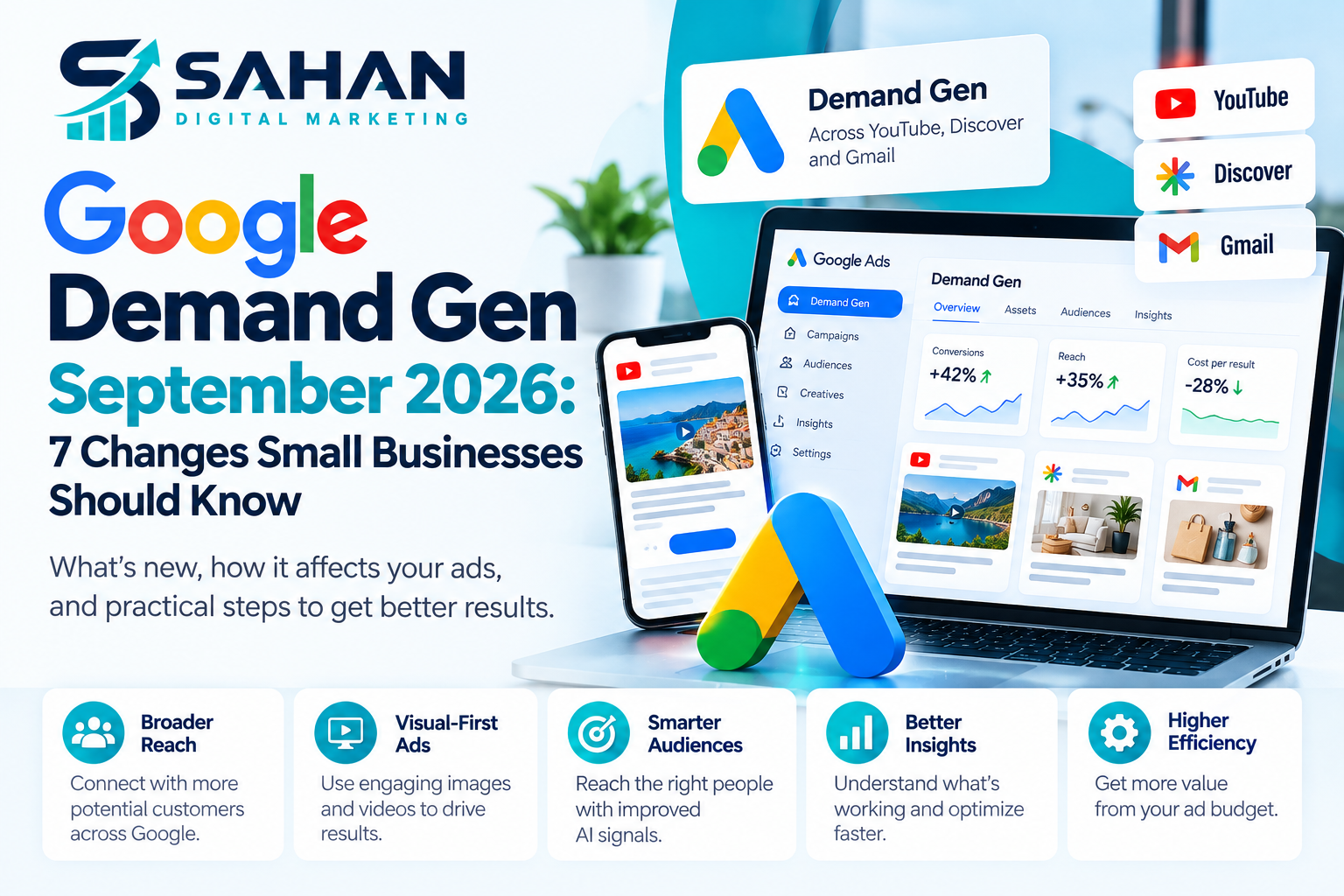
Google Demand Gen September 2026 updates are giving advertisers new ways to turn visual discovery into measurable action across YouTube, Gmail and Google Maps. The latest release includes a conversational Business Agent for YouTube ads, one-click landing-page experiences and new local-commerce capabilities.
For small businesses, the important question is not whether every new feature should be adopted immediately. It is which changes can shorten the path from discovery to purchase without weakening measurement, creative quality or customer trust.
What changed in Google Demand Gen September 2026?
Google announced its September Demand Gen Drop on September 24, 2026. The release focuses on reducing friction between seeing an ad, learning about a product and taking action, particularly as businesses prepare for high-intent seasonal shopping periods.
1. Business Agent is coming alongside YouTube ads
Google says viewers can engage with a conversational Business Agent alongside YouTube video ads that use product feeds. Instead of leaving the viewing experience to search for basic product information, shoppers can ask questions about the product or brand in context.
This could be useful for businesses selling products that naturally generate questions about compatibility, sizing, specifications, availability or use cases. The opportunity is strongest when product data is accurate and answers can genuinely help a buyer make a decision.
2. One-click experiences reduce landing-page friction
Google is simplifying the path from image ads to advertiser landing pages. On YouTube Shorts, advertisers using 9:16 full-bleed image ads can provide a one-click experience. Gmail image ads are also gaining a simpler one-click path.
Less friction can be valuable, but faster clicks make landing-page quality even more important. A visitor who reaches the page quickly should immediately see a clear offer, relevant message, strong mobile experience and obvious next action.
Sahan’s website conversion optimization guide explains how to improve the page after the advertising click.
3. Gmail becomes more important inside Demand Gen
Google says advertisers that add Gmail to Demand Gen campaigns have, on average, seen image creatives achieve a 40% increase in conversions at the same ROI, based on Google internal global data from February 2026. That is an aggregate platform result, not a guarantee for an individual advertiser.
Small businesses should therefore test Gmail as an incremental channel rather than assuming the benchmark will automatically apply to their own audience, offer or creative.
4. Google Maps gains Affiliate Location Extensions
Affiliate Location Extensions can help retail networks and dealerships capture local demand through promoted pins in Google Maps as people browse, search and navigate.
This reinforces a broader marketing trend: discovery, advertising and local intent are becoming more connected. Businesses with physical availability should keep location information accurate and make sure customers can quickly understand where products or services can be found.
For businesses improving local visibility, see Sahan’s local SEO guide for small businesses.
5. Creative format matters more on Shorts
The one-click Shorts experience specifically highlights 9:16 full-bleed image ads. That means businesses should not simply resize a desktop creative and expect it to work well. Vertical creative needs a clear focal point, readable messaging and enough visual simplicity to communicate in a fast-scrolling environment.
6. Product data becomes part of the customer experience
Conversational advertising depends on the information available to the system. If product feeds contain outdated prices, weak descriptions or incomplete attributes, an AI-assisted buying experience can inherit those weaknesses.
Before expanding AI-assisted advertising, businesses should review product titles, descriptions, images, availability and landing-page consistency. Better automation starts with better source data.
7. Measure business outcomes, not just engagement
New ad experiences can generate attention, clicks and conversations, but small businesses still need to measure what happens afterward. Track qualified leads, sales, cost per acquisition and revenue—not simply impressions or interaction rates.
That also makes first-party measurement increasingly valuable. Sahan’s first-party data guide explains how businesses can build a stronger measurement foundation.
What small businesses should do now
Start by checking whether Demand Gen already plays a meaningful role in your advertising strategy. If it does, review your mobile landing pages, product feed quality and vertical creative before adding new experiences. Test one change at a time where possible so you can understand whether it actually improves conversions or customer quality.
Businesses that do not currently use Demand Gen should not adopt it simply because new AI features are available. Channel choice should follow customer behavior, campaign goals and measurement readiness.
Final takeaway
The Google Demand Gen September 2026 update shows how quickly advertising is moving toward conversational, low-friction experiences. Business Agent can help answer product questions in context, one-click ads can shorten the journey to a landing page, and Maps integrations can connect digital discovery with local buying intent.
For small businesses, the strongest approach is disciplined testing: improve the data and landing page first, use creative built for the placement, and judge each new feature by the business result it produces.