

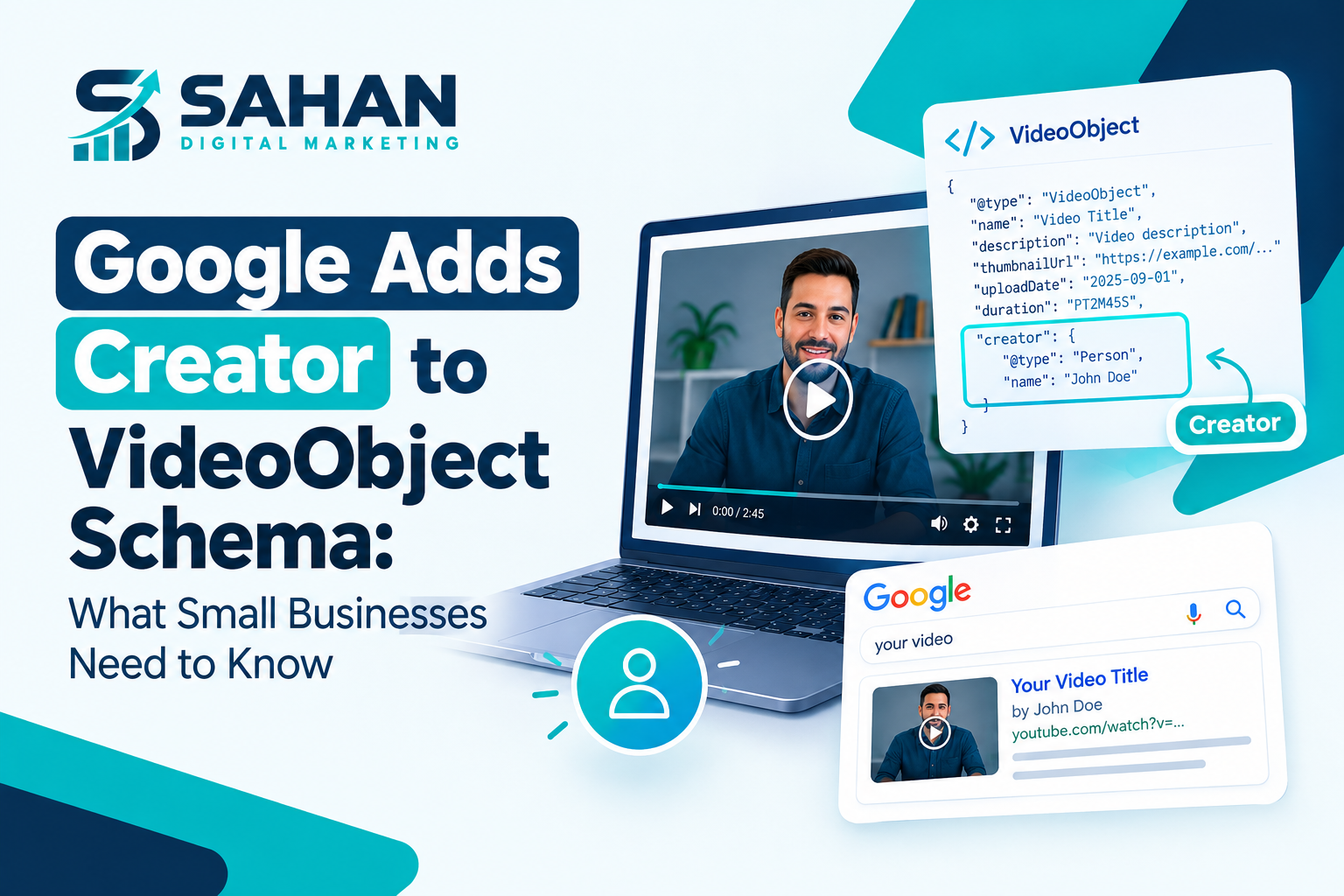
Google has updated its documentation for VideoObject structured data, adding support documentation for the creator property and clarifying support for author. For small businesses that publish videos on their websites, the change is a useful reminder to make video ownership and creator information clear and structured.
What Google changed
On September 24, 2026, Google Search Central documented the creator property for VideoObject structured data and updated its documentation for interactionStatistic. Google says the change is intended to document support for creator and author properties and clarify supported interaction types.
This is a documentation update, not a promise that adding the property will automatically produce a richer search result. Google also states that structured data does not guarantee that a particular search feature will appear.
Why the creator property matters
For a business that publishes tutorials, product demonstrations, interviews, webinars, or educational videos, creator information can help describe who or what organization is responsible for the video.
The creator can be represented as a person or an organization. Businesses should use information that accurately reflects the real creator of the video rather than adding markup simply to influence search results.
What small businesses should check
1. Identify the actual creator
Review the videos published on important pages and identify whether the creator is an individual, your business, or another organization. Keep the structured data consistent with the visible information on the page.
2. Review your VideoObject markup
If your site already uses VideoObject structured data, check whether the markup accurately describes the video. Google recommends required properties such as the video name, thumbnail URL, and upload date, with properties such as description, duration, contentUrl, and embedUrl providing additional information.
3. Keep creator and author information accurate
Do not use a generic or unrelated creator simply because it is more recognizable. The markup should represent the real source of the video and should agree with the content users can see.
4. Validate before publishing changes
Google recommends validating structured data with the Rich Results Test and checking how Google sees the page with Search Console’s URL Inspection tool. Fix critical structured-data problems before rolling changes across a large number of pages.
5. Prioritize pages where video matters
Small businesses do not need to add complicated markup to every page. Start with genuine video watch pages that support customers, explain products or services, answer important questions, or demonstrate expertise.
What this does not mean
This update does not mean that every website needs to create video content or that adding creator guarantees higher rankings. Structured data helps search engines understand content, but Google decides whether and how eligible features appear in search.
A practical VideoObject checklist
- Use a unique and accurate video name.
- Provide a valid thumbnail URL.
- Use the correct original upload date.
- Describe the video accurately.
- Use contentUrl when the actual video file is available, or embedUrl where appropriate.
- Identify the genuine creator when relevant.
- Keep structured data consistent with visible page content.
- Validate the markup before wider deployment.
How this fits into modern search
Google’s recent Search changes continue to make it more useful for site owners to understand how different content formats are discovered. Google also introduced multimodal Search performance reporting in Search Console on September 24, including searches involving Lens, Circle to Search, image uploads, and Chrome’s “Search this image” feature. This makes accurate visual and video content information increasingly relevant to businesses that rely on search visibility.
For a broader look at that development, see our guide to Google Search Console multimodal search reporting.
Final takeaway
The September 2026 VideoObject documentation update is a practical reason for small businesses to review how their video content is described. The priority should be accuracy: identify the real creator, keep VideoObject markup complete, validate important pages, and avoid adding structured data that does not match the content users can see.
Source: Google Search Central documentation updates and Video structured-data documentation, updated September 24, 2026.