
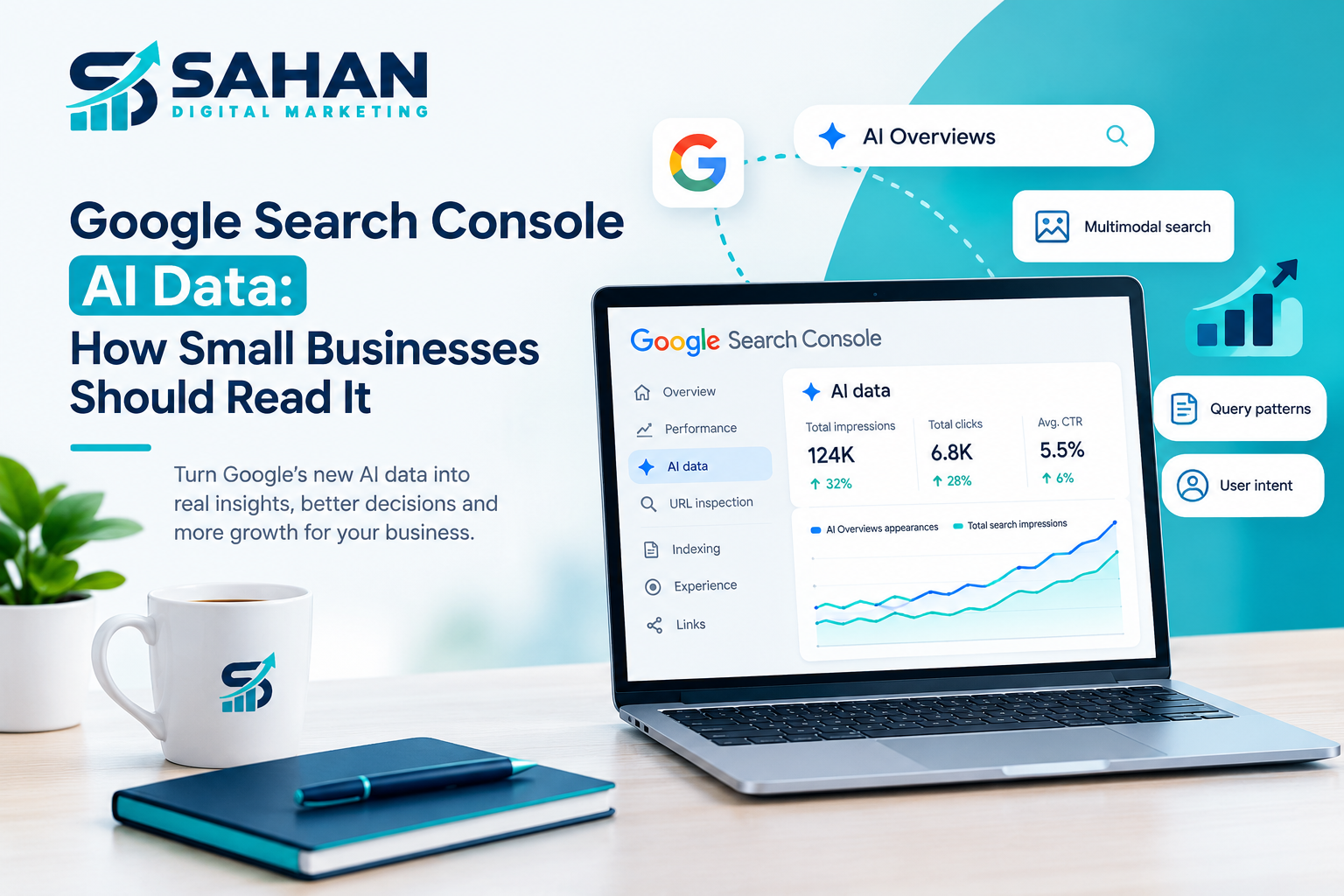
Google Search Console is becoming more useful for businesses trying to understand visibility in AI-powered search. Since August 31, 2026, Google’s generative-AI performance insights have been available globally, giving site owners a dedicated view of how their pages appear in AI Overviews and AI Mode.
That creates an important opportunity for small businesses—but also an easy measurement mistake. AI visibility data should not be treated as a replacement for traditional rankings. It answers a different question: whether your pages are being surfaced inside Google’s newer AI search experiences.
Here is how small-business owners can use the data without turning every fluctuation into an SEO emergency.
What Google Search Console’s AI Data Actually Measures
Google’s generative-AI performance reporting provides information about impressions, pages, countries and dates for appearances in generative AI features. Search reporting also includes device information.
In practical terms, this helps answer:
- Which pages are appearing in AI search experiences?
- Are those appearances increasing or decreasing?
- Which countries are seeing the content?
- Which pages are getting repeated AI-search exposure?
- Which topics are gaining visibility before they produce significant traditional traffic?
Google says AI Overviews now reach more than 2.5 billion monthly active users, while AI Mode has passed one billion monthly users. That makes this reporting worth watching—but not worth obsessing over.
1. Start With Pages, Not Just Numbers
A large impression number is less useful if you do not know which pages generated it.
Look first at the URLs appearing in the AI performance report. Group them by purpose: service pages, product or category pages, educational articles, local pages, and comparison or decision-support content.
This can reveal which types of content are repeatedly being surfaced in AI search. If several related articles begin appearing, that may also show where your site is developing topical strength.
2. Do Not Treat AI Impressions Like a Ranking Position
This is the most important distinction.
Traditional Search Console reporting includes clicks, impressions, CTR and average position. The generative-AI reporting is designed to show visibility within AI features instead.
So avoid conclusions such as: “My AI impressions increased, therefore my page moved from position 8 to position 3.”
That is not what the report is telling you. Instead, ask whether pages are appearing more often, which topics are represented, and whether the visibility connects to useful business outcomes.
3. Compare AI Visibility With Traditional Search
The real value appears when you compare the two views.
A page might have strong traditional search impressions but little AI visibility, modest traditional traffic but growing AI visibility, high AI visibility but few clicks, or strength in both areas. Each situation suggests a different editorial question.
If traditional impressions are strong but AI visibility is weak, review whether the page gives a direct, useful answer and whether it adds something beyond a generic summary.
If AI visibility is growing but clicks remain limited, do not immediately assume the page has failed. AI search can satisfy part of a user’s information need before the person visits a website. Examine the page’s role in the wider customer journey instead.
4. Find the Pages Google Keeps Reusing
Repeated visibility can be more interesting than a single spike.
Suppose a small business has many published articles but only a handful repeatedly appear in AI search reporting. Those pages deserve closer editorial analysis.
Look for shared characteristics:
- They answer a specific question clearly.
- They use trustworthy sources.
- They contain original explanations or examples.
- They avoid unnecessary filler.
- They connect naturally to related pages.
- The title and content accurately match the searcher’s need.
Google’s current generative-AI guidance recommends useful, reliable, non-commodity content and says unique viewpoints can help content stand out in generative AI search.
5. Use Countries to Find Unexpected Demand
The country dimension can reveal where content is being surfaced even when your assumptions about the audience are different.
A business serving one primary market might discover that an informational article is receiving AI-search impressions in several countries. That does not automatically mean it needs international landing pages.
Instead, ask why the content is relevant there. For an international topic, the finding may justify clearer geographic explanations or localized examples. For a strictly local service, it may simply confirm that the informational content has broader research value.
6. Use the Report to Decide What to Improve
Search data becomes useful when it changes a decision.
If a page has growing AI visibility, avoid constantly rewriting it because the numbers move from one reporting period to another. If a page has little visibility, first check whether the topic matters to your audience and whether the page provides something genuinely useful.
Google’s guidance says site owners should continue prioritizing foundational SEO, technical accessibility and unique, valuable content rather than chasing special “AI SEO” tricks. It also recommends using Search Console’s generative-AI performance report to understand visibility.
Measure → identify patterns → inspect the page → improve the value → measure again.
7. Connect the Data to Business Intent
AI visibility is not the final business goal. A small business ultimately needs qualified visitors, enquiries, sales, bookings, sign-ups or another meaningful action.
After identifying pages that appear in AI search, check whether those pages support a real customer journey. An informational article should make the next relevant step easy to understand without turning every paragraph into a sales pitch.
A technical guide can naturally link to a related service page, checklist or deeper article. This gives AI-search visibility a role inside the wider site rather than treating it as a vanity metric.
What Small Businesses Should Not Do
Do not create dozens of new articles simply because the AI report exists. Do not rewrite every page into artificial “AI-friendly” wording. Do not assume a third-party tool can reveal Google’s private AI ranking signals. And do not mistake an AI-search impression for a guaranteed click or customer.
Google’s documentation emphasizes useful, people-first content rather than unsupported optimization tactics.
A Simple Monthly AI Visibility Review
- Review the generative-AI performance report.
- List the pages receiving visibility.
- Group them by topic and business purpose.
- Compare their traditional Search Console performance.
- Identify pages with meaningful visibility but weak customer pathways.
- Improve only where there is a clear reason.
- Record the change and review the trend later.
That process is deliberately boring. Good measurement should reduce guesswork, not create another daily ranking obsession.
The Bigger Lesson
Google Search is no longer presenting visibility through one simple results page. AI Overviews, AI Mode and multimodal search are changing how people discover information, while Search Console is adding reporting to help website owners understand those experiences.
For small businesses, the opportunity is not to chase every new AI feature. It is to use the new data to discover which pages genuinely help people, then make those pages clearer, more trustworthy and more useful.
If a page earns visibility in AI search, the next question should not be “How do I make the number bigger?”
Ask instead: “Why is this page being surfaced, and how can we make it even more useful to the person who finds it?”
Related Sahan Guides
- Google AI Search: 7 Visibility Signals for Small Businesses
- Google Search Profile Badge: What Small Businesses Should Know
- AI Content Review Checklist for Small Businesses