
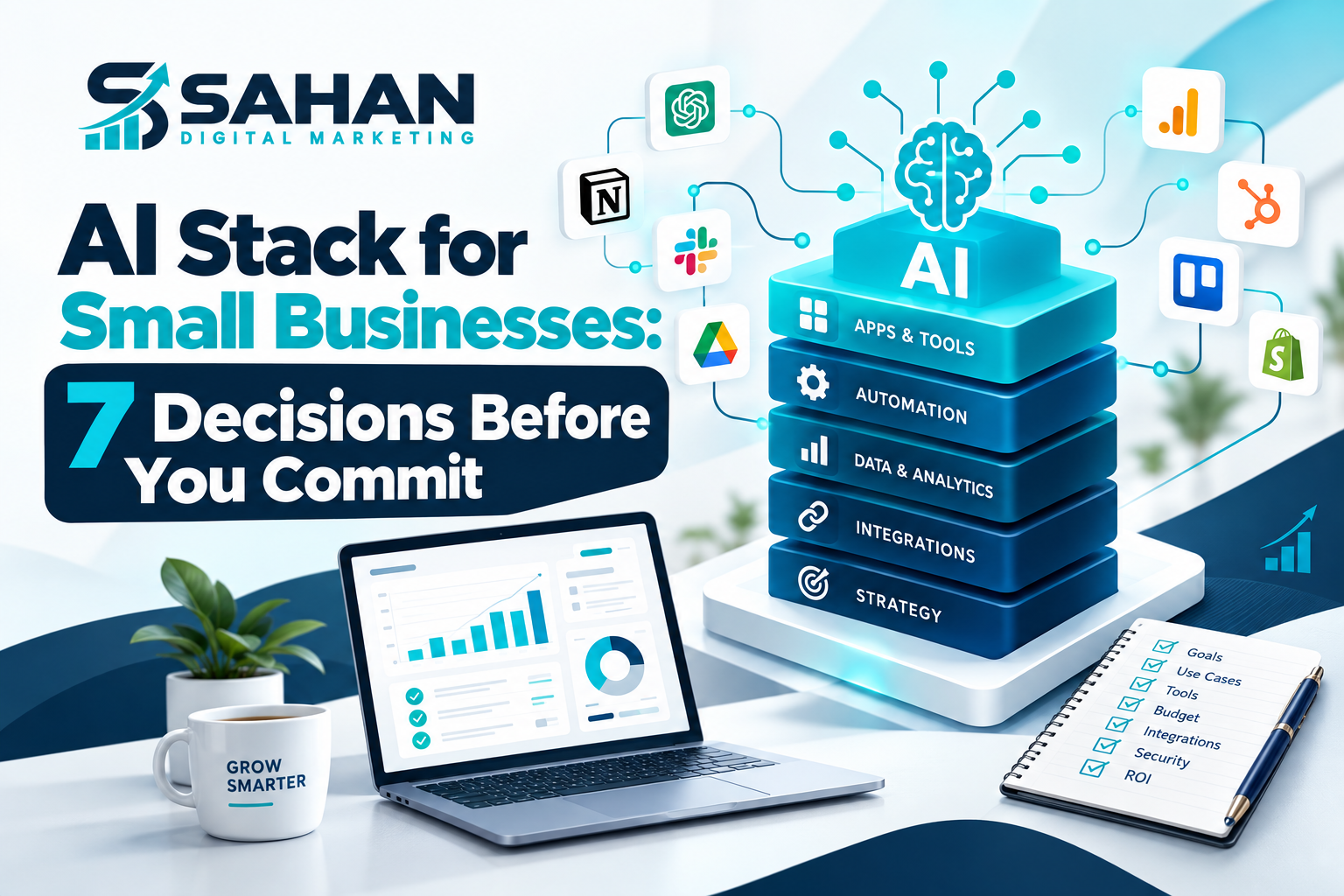
Choosing an AI stack for small businesses is becoming a business decision, not just a technical one. Google Cloud says fast-growing startups are increasingly evaluating their AI infrastructure around three priorities: flexibility, the ability to build and manage agents, and security for AI workloads. Small businesses do not need the same infrastructure as a venture-backed startup, but the decision framework is useful.
This guide translates those priorities into practical questions a smaller company can use before paying for another AI platform, connecting business data or automating important workflows.
1. Choose flexibility before lock-in
AI tools change quickly. A small business should avoid designing a critical workflow around a feature that cannot be exported, integrated or replaced. Before committing, check whether you can move your data, connect common business tools, use an API if needed and switch models or providers without rebuilding everything.
Flexibility also means matching cost to the task. Routine summarization and classification may not require the same model capability as complex analysis or customer-facing automation.
2. Separate experiments from production workflows
A useful prototype can be built in an afternoon, but production use requires stronger controls. Ask who owns the workflow, what happens when the model is wrong, where data is stored and how a human can intervene.
For businesses moving beyond simple chat tools, our AI business process automation guide explains how to map a process before automating it.
3. Treat AI agents like users with permissions
An agent that can read files, send messages or update systems should not receive unlimited access simply because it is automated. Give it only the permissions required for its task, log important actions and require approval before sensitive or irreversible steps.
Our AI agent security controls provide a practical checklist for access, logging, data boundaries and human oversight.
4. Build around business data you can trust
AI output is only as useful as the information available to it. Clean customer records, accurate product information, documented procedures and consistent analytics can create more value than adding another model.
Before connecting AI to a CRM, document store or analytics platform, identify which information is authoritative and who maintains it. This reduces the chance that automation amplifies outdated or conflicting data.
5. Make security part of the buying decision
Security should be evaluated before deployment, not after an incident. Review authentication, encryption, administrator controls, retention settings, audit logs and how the provider handles customer data. For sensitive workflows, understand whether prompts or outputs may be used to improve models and what controls are available.
6. Track the full cost of the workflow
The subscription price is only one part of AI cost. Include integration work, employee review time, API usage, data storage, monitoring and the cost of correcting mistakes. A cheap tool that creates significant manual cleanup may be more expensive than a better-controlled alternative.
7. Design an exit plan before you need one
For every important AI workflow, document how you would continue operating if the provider changed pricing, removed a feature or experienced an outage. Keep copies of critical prompts, procedures and business data in formats you control.
This is the AI equivalent of business continuity planning: innovation should increase capability without creating a new single point of failure.
A simple AI stack checklist
Before approving a tool, ask: Does it solve a defined business problem? Can our data be exported? Are permissions granular? Can important actions be reviewed? Do we understand total cost? Is the provider appropriate for the sensitivity of our data? Can we replace the tool without stopping the business?
Final takeaway
The best AI stack is not the one with the longest feature list. For a small business, it is the smallest set of tools that reliably supports useful workflows, protects important information and can evolve as the technology changes. Flexibility, governance and security are strategic advantages—not enterprise luxuries.
Sources
Primary source: Google Cloud — The three things today’s hottest startups are looking for in their AI stack (September 24, 2026).