
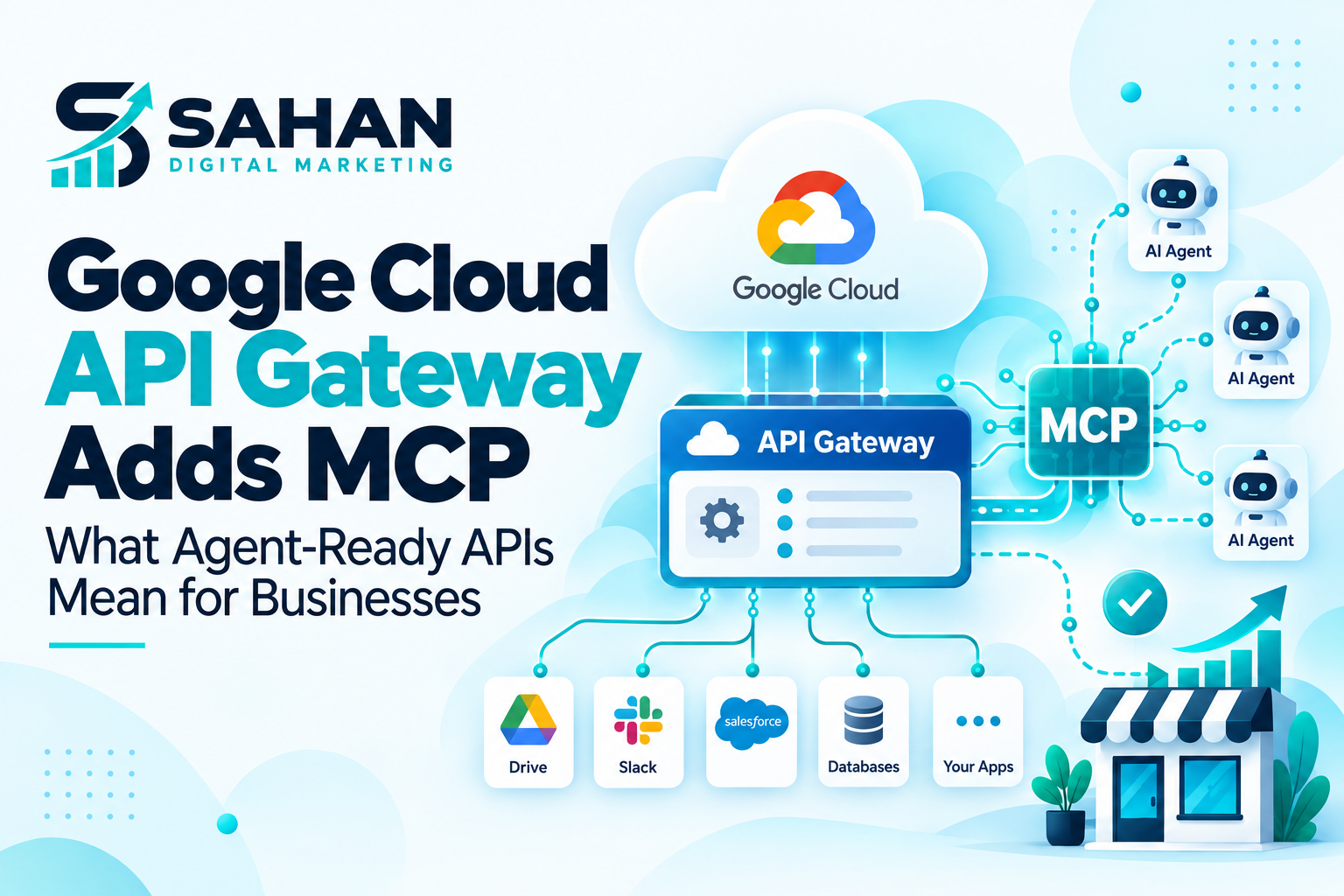
Google Cloud API Gateway MCP support gives businesses a way to expose existing REST APIs to AI agents without building a separate Model Context Protocol server. Google’s API Gateway release notes list MCP support as a Public Preview feature on September 11, 2026.
The development matters because many companies already have useful business functions behind APIs—orders, inventory, customer data, support systems and internal workflows. MCP gives AI agents a standardized way to discover and call those capabilities.
What changed with Google Cloud API Gateway MCP?
Google Cloud API Gateway can now act as a remote MCP server. Developers can annotate an existing OpenAPI 3.x specification, deploy it through API Gateway, and expose selected REST operations as agent-ready tools.
Google says the gateway translates MCP tool calls into normal REST requests while continuing to apply the authentication, quotas and logging already configured for the underlying API. That can reduce the amount of separate infrastructure a team has to build and maintain.
1. Existing APIs can become AI-agent tools
A business does not necessarily need to rebuild its backend for an AI-agent strategy. Existing API operations can be selectively exposed as tools. An order-status endpoint, for example, could become a tool an approved support agent uses when a customer asks where an order is.
2. MCP can reduce custom integration work
Without gateway-level support, teams may need a separate MCP server that repeats routing, authentication and operational logic. Google’s approach moves that translation into the API gateway. For suitable systems, this can simplify architecture and reduce duplicated maintenance.
3. Authentication still matters
Making an API discoverable to agents does not remove the need for access control. Google says tool calls continue to enforce the authentication required by the underlying REST operation. Businesses should use least-privilege credentials and expose only the operations an agent genuinely needs.
This is especially important as companies expand automation. Sahan’s AI agent security guide explains why agent permissions, logging and human oversight should be designed before autonomous access expands.
4. Tool descriptions become part of the interface
AI agents need to understand when a tool should be used. Google emphasizes meaningful tool descriptions that explain both what an operation does and when it is appropriate. This makes API documentation increasingly important not only for human developers but also for machine decision-making.
5. Logging and quotas become governance tools
When agents call business systems automatically, observability becomes essential. Existing gateway logging and quotas can help teams see which operations are being used, control excessive requests and investigate unexpected behavior. Businesses should define normal usage before scaling automation.
6. Start with a narrow business workflow
Small and midsize businesses do not need to expose every API to AI. A better approach is to choose one bounded workflow with measurable value, such as checking order status, retrieving product availability or opening a support request. Test accuracy, permissions and failure handling before expanding.
7. Keep human approval for high-impact actions
Reading information and changing business records carry different levels of risk. Actions involving payments, account permissions, customer data deletion or irreversible changes should have stronger authorization and, where appropriate, human confirmation.
Businesses already exploring automation can also review Sahan’s AI business process automation guide for a practical way to choose workflows without automating everything at once.
What are the current limitations?
Google describes the feature as a Public Preview. It currently targets REST APIs described with OpenAPI 3.x. Google also notes limits around features such as streaming and certain complex schemas, so production teams should verify the current documentation before committing critical workflows.
What this means for businesses
The bigger trend is clear: AI agents are moving from answering questions toward securely using business tools. API gateways can become an important control point because they already sit between applications and backend services. Companies that maintain clean APIs, clear permissions and reliable logging will be better positioned to adopt agent-based automation responsibly.
Final takeaway
Google Cloud API Gateway MCP support can make existing APIs easier for AI agents to discover and use without requiring a separate MCP server for every integration. The opportunity is meaningful, but businesses should start small, protect tool discovery and execution, keep permissions narrow, and measure what the agent actually does.
Source: Google Cloud API Gateway release notes — MCP Public Preview, September 11, 2026.