

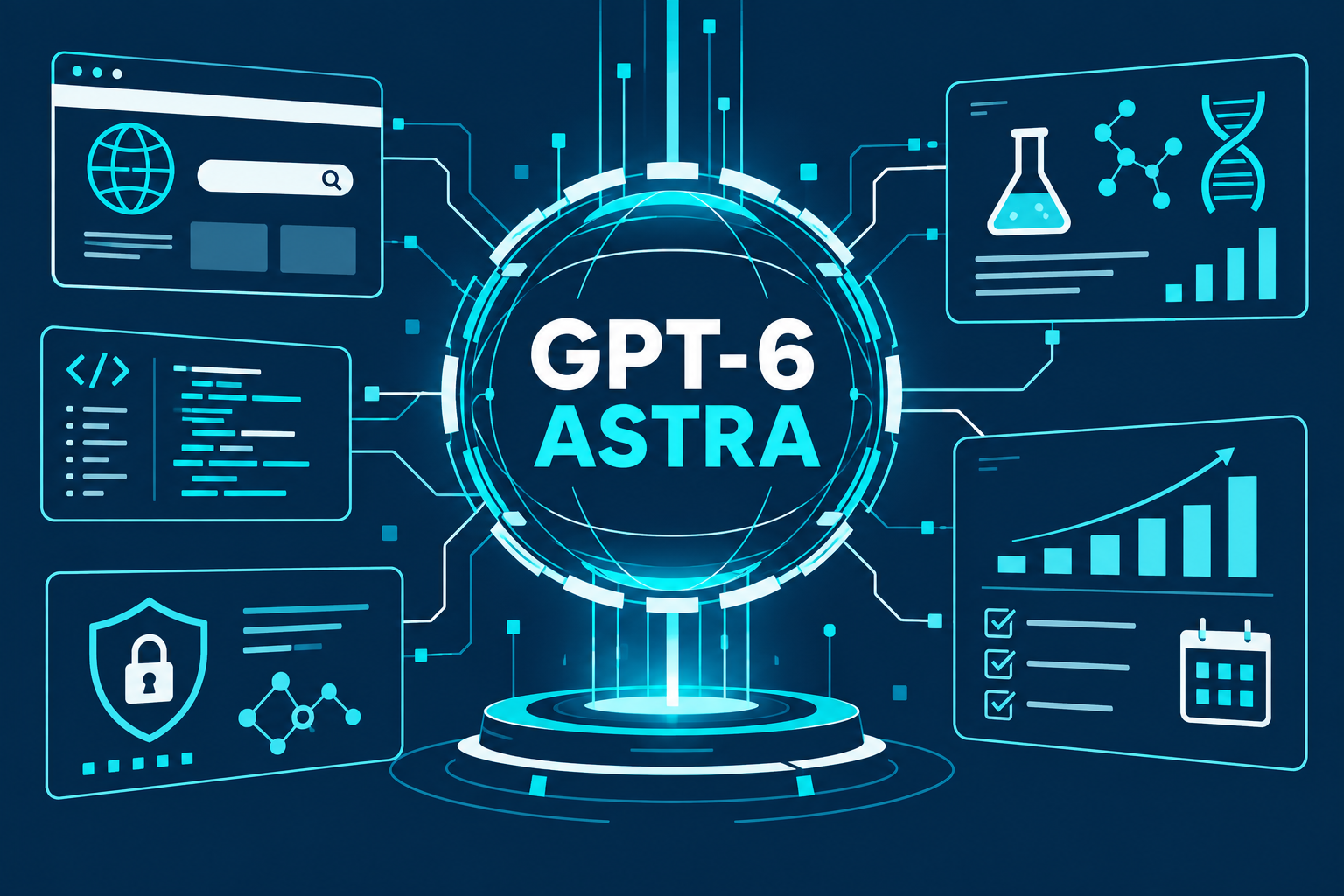
GPT-6 Astra is OpenAI’s newest frontier model, designed for demanding computer-use, browsing, software-engineering, cybersecurity, scientific and professional tasks. OpenAI describes Astra as its most capable broadly deployed model and says it represents a major improvement in speed, accuracy and alignment.
Thank you for reading this post, don't forget to subscribe!The launch matters to businesses because advanced AI is moving beyond answering questions. Models are increasingly able to navigate software, complete multi-step workflows, analyse documents, test websites and help operate digital systems. Those capabilities could improve productivity—but they also require stronger oversight.
What Is GPT-6 Astra?
According to OpenAI, GPT-6 Astra combines advances in pre-training, reinforcement learning and alignment. The company says the model reaches state-of-the-art performance across computer use, browsing, coding, cybersecurity, science and professional work.
OpenAI lists examples such as completing online forms, updating customer records, organising calendars, conducting research, analysing scientific data, creating websites and running frontend quality checks.
Why GPT-6 Astra Is Different
More capable computer use
Astra is designed to carry out actions across digital interfaces, not simply explain the steps. This could help businesses reduce repetitive administrative work, but permissions should be limited and important actions should require human approval.
Stronger professional workflows
OpenAI has published customer examples involving legal document review and game prototyping. These are company-reported results, not guarantees for every user, but they indicate the direction of AI-assisted work.
Critical cybersecurity capability
OpenAI says Astra is its first model to meet the “Critical” cybersecurity capability threshold under its Preparedness Framework. The company says this means the model may be able to find previously unknown vulnerabilities and develop methods to exploit well-protected systems when given suitable tools and access.
This capability is important for defensive security research, but it also explains why access controls, monitoring and safeguards are central to the launch.
Five Business Uses Worth Testing
- Research: collect and organise information while keeping source links for human verification.
- Website quality assurance: test forms, navigation, responsive layouts and common customer journeys.
- Customer operations: draft responses and update approved records with restricted permissions.
- Document analysis: identify key clauses, inconsistencies and action items before expert review.
- Software development: help plan, write, test and explain code under developer supervision.
Risks Small Businesses Should Manage
Do not give a new AI system unrestricted access to email, payments, customer data or administrator accounts. Begin with a narrow task, test the output and maintain an activity log. Sensitive or irreversible actions should require approval from a responsible person.
Businesses should also check data-handling terms, retention policies, accuracy and legal obligations. Even an advanced model can misunderstand context or produce an incorrect result.
A Safe Adoption Checklist
- Choose one measurable workflow.
- Remove unnecessary permissions.
- Keep confidential information out of unapproved tools.
- Require human review for external communications and important decisions.
- Test failure cases, not only successful demonstrations.
- Track time saved, errors and customer impact.
- Create a shutdown procedure if behaviour becomes unexpected.
What GPT-6 Astra Means for the AI Market
The launch increases pressure on AI companies to compete on reliable action, not only fluent text. For software providers, agencies and professional firms, the opportunity is to redesign workflows around human accountability and machine speed.
For small businesses, the best strategy is not to automate everything immediately. Start with low-risk work where results are easy to verify, then expand only after the process proves reliable.
Final Takeaway
GPT-6 Astra signals a new stage of AI-assisted work. Its computer-use and professional capabilities may save significant time, while its cybersecurity power makes careful access control essential. Businesses should adopt it deliberately, measure real outcomes and keep people responsible for consequential decisions.
Read our related guides on AI agents for small businesses and AI cybersecurity for small businesses.
Editorial note: This article is based on OpenAI’s official launch and safety materials. Product capabilities and availability may change. Business examples should be independently tested.