
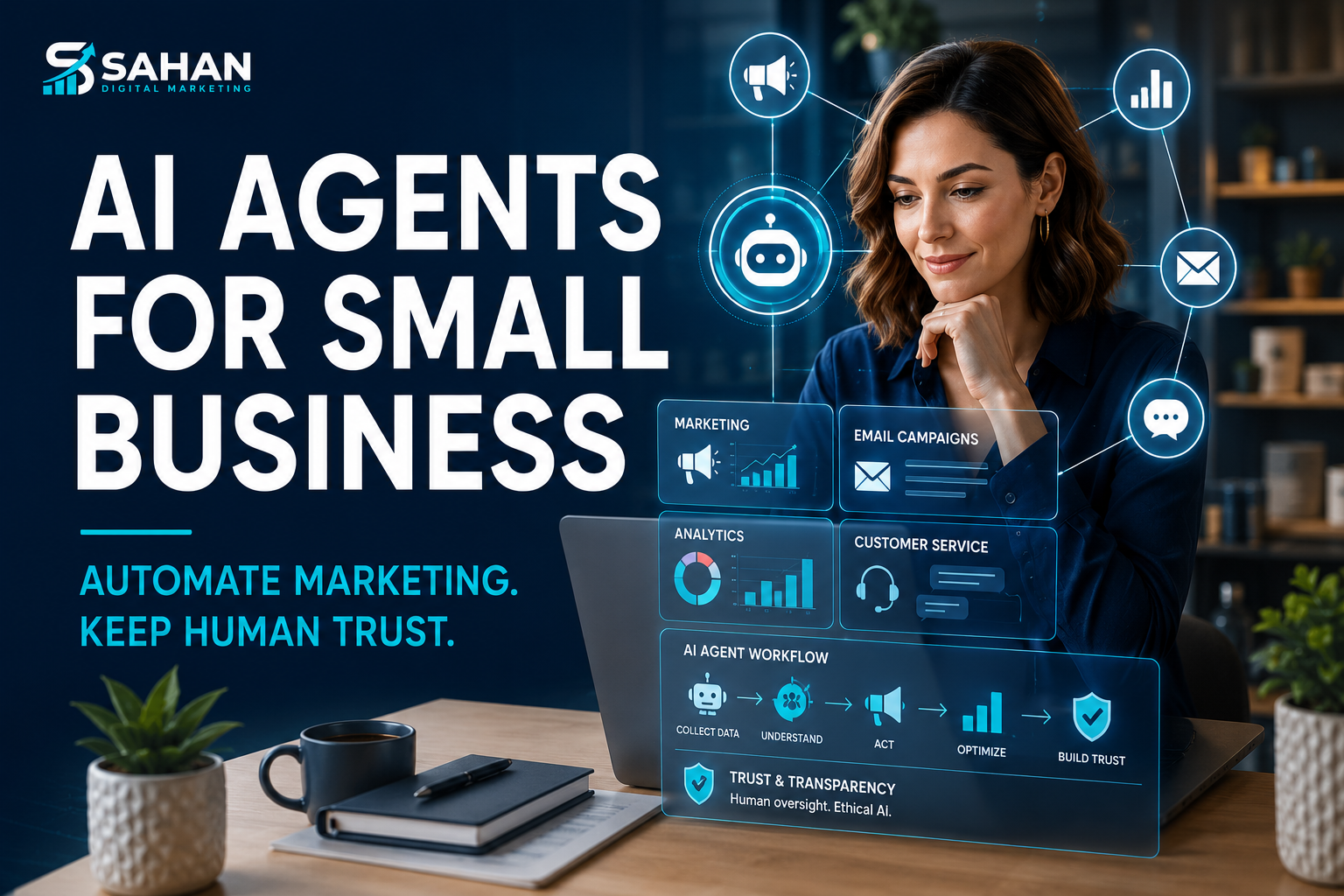
AI agents for small business are moving from experimental tools to practical digital assistants that can research customers, prepare campaigns, organize leads, summarize performance, and support daily operations. For small companies with limited time and staff, that shift creates a major opportunity—but only when automation is introduced carefully.
The competitive advantage in 2026 is not simply using more artificial intelligence. It is knowing which tasks to automate, which decisions require human judgment, and how to protect the trust customers place in a business.
What Are AI Agents for Small Business?
An AI agent is software designed to work toward a goal through a sequence of actions. A standard chatbot normally responds to one prompt at a time. An agent can interpret an objective, create a plan, use connected tools, complete several steps, and report the result for approval.
For example, a small business owner could ask an agent to review last month’s website traffic, identify the best-performing article, suggest three related social posts, prepare an email draft, and organize the results in a content calendar. The owner still reviews the work, but much of the repetitive preparation is completed automatically.
Google Cloud’s AI Agent Trends 2026 report describes agents as an important part of modern business workflows, customer experiences, security operations, and employee productivity. The practical message for smaller companies is clear: begin with focused workflows that solve real problems rather than trying to automate everything at once.
Why AI Agents Matter in 2026
AI has quickly become a standard marketing tool. According to HubSpot’s 2026 State of Marketing Report, 80% of marketers use AI for content creation and 75% use it for media production. The same report says 61% believe marketing is experiencing its biggest disruption in 20 years because of AI.
This widespread adoption changes the source of competitive advantage. Access to AI is no longer enough. Businesses now need better strategy, reliable data, distinctive branding, and responsible human supervision. When every competitor can generate content quickly, generic output becomes easier to ignore.
McKinsey’s 2026 State of AI survey also shows organizations expanding AI across more business functions, including agentic workflows. However, high-performing organizations are more active in managing technical vulnerabilities and unintended actions. That balance between adoption and control is especially important for small businesses, where one serious mistake can damage a hard-earned reputation.
Seven Practical Uses of AI Agents
1. Customer and Market Research
An agent can collect customer questions, organize review themes, compare competitor messaging, and summarize market changes. This reduces research time and gives the owner a clearer picture of what customers need. Final conclusions should still be checked against reliable sources and real customer conversations.
2. Content Planning
AI agents for small business can turn one strategic topic into a coordinated content plan for a blog, newsletter, and social media. They can create briefs, propose headings, assign publication dates, and identify related pages for internal linking. Human editing remains essential for accuracy, originality, and brand voice.
3. Search Engine Optimization
An agent can help review search intent, identify missing metadata, find outdated pages, and suggest internal links. It can also monitor whether important pages are indexed. For a complete foundation, businesses should combine this automation with the principles in our local SEO guide for small businesses.
4. Lead Organization and Follow-Up
With the right permissions, an agent can classify leads, summarize enquiries, prepare follow-up drafts, and remind a team when a response is due. It should not send sensitive or high-value communications without review. A simple approval step can preserve speed while preventing embarrassing mistakes.
5. Customer-Service Support
AI can answer routine questions, recommend relevant help articles, and prepare responses for a human representative. The best systems clearly explain when customers are interacting with automation and provide an easy route to a person when the issue is complex, emotional, or sensitive.
6. Campaign Reporting
Instead of manually combining data from different platforms, a business can use an agent to summarize traffic, advertising, email, and conversion results. The report should connect activity to business outcomes rather than celebrating impressions or clicks without context.
7. Repetitive Administrative Work
Meeting summaries, task organization, document classification, inventory alerts, and recurring reports are strong starting points. These tasks are structured, measurable, and easier to verify than decisions involving legal, financial, employment, or reputational risk.
What Small Businesses Should Not Fully Automate
- Final approval of public claims, prices, guarantees, or legal statements
- Responses to complaints, disputes, emergencies, or vulnerable customers
- Hiring, firing, credit, medical, or other high-impact decisions
- Publishing content without checking facts, originality, and tone
- Access to financial accounts or sensitive customer information without strict controls
- Brand strategy and creative direction that require genuine human perspective
The goal is not to remove people from the business. It is to remove unnecessary repetition so people can spend more time on judgment, relationships, creativity, and service.
A Safe Five-Step Adoption Plan
Step 1: Choose One Measurable Problem
Start with a task that happens frequently and consumes time, such as preparing a weekly marketing report. Define the current time required, the desired result, and the person responsible for checking the agent’s work.
Step 2: Limit Data and Permissions
Give the agent access only to the information and tools it needs. Avoid broad administrator access. Review privacy requirements before sharing customer records, confidential documents, or payment information.
Step 3: Keep Human Approval
Require approval before an agent publishes content, sends messages, changes prices, spends advertising money, or modifies important records. Human-in-the-loop workflows are slower than complete automation, but they are far safer during early adoption.
Step 4: Test Accuracy and Brand Voice
Use a small test set and compare results with work completed manually. Check facts, calculations, links, customer tone, and compliance. Record common failures so the workflow can be improved rather than repeatedly making the same mistake.
Step 5: Measure Business Value
Track time saved, response speed, lead quality, conversion rate, customer satisfaction, and error frequency. If the agent creates more review work than it saves, simplify the task or stop the workflow.
AI Automation Still Needs Human Marketing
Customers do not build loyalty with workflows; they build loyalty with businesses that consistently solve problems and communicate honestly. AI can make execution faster, but positioning, empathy, taste, and accountability remain human responsibilities.
This is also why a clear digital strategy matters. Our digital marketing guide for small businesses explains how SEO, content, social media, and email work together. AI agents should support that strategy—not replace it.
Frequently Asked Questions
Are AI agents affordable for small businesses?
Many businesses can begin with tools they already use and automate one narrow workflow. The true cost includes setup, monitoring, staff training, and error correction—not only the software subscription.
Will AI agents replace employees?
Some tasks will change, but practical small-business adoption is usually focused on reducing repetitive work and helping limited teams operate more efficiently. McKinsey reported that 14% of surveyed organizations using AI experienced an overall workforce decline attributable to AI in the previous year, below the 32% that had expected reductions.
What is the best first AI workflow?
A weekly reporting or content-planning workflow is a strong first project because the inputs, output, review process, and time savings can be measured clearly.
Final Thoughts
AI agents for small business can provide meaningful value in 2026 by reducing repetitive work, improving response speed, and helping small teams execute better marketing. Success depends on starting with a clear problem, restricting access, reviewing important actions, and measuring real outcomes.
The businesses most likely to benefit will not be those that automate the most. They will be those that combine capable technology with reliable data, strong judgment, distinctive branding, and customer trust.