

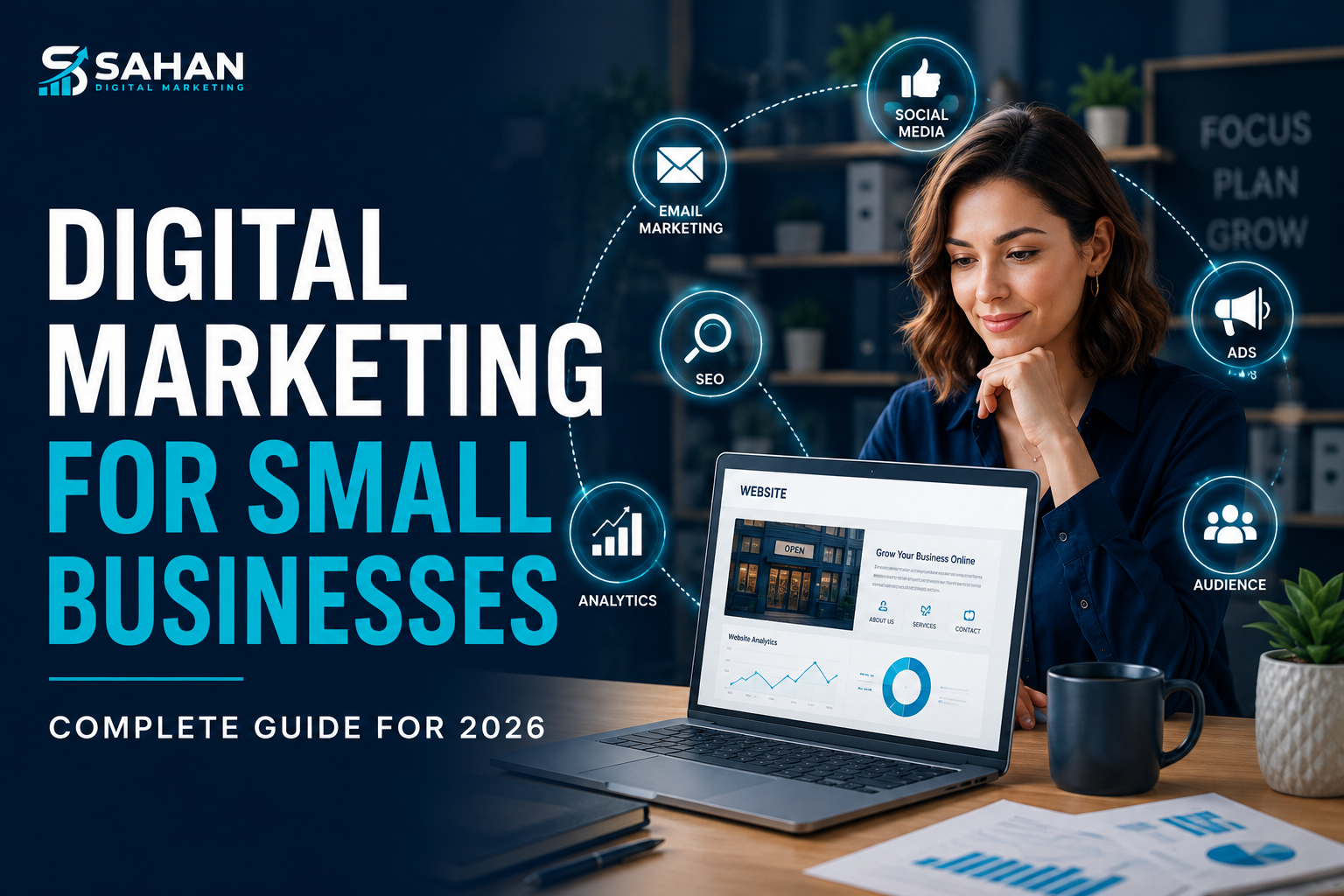
Digital marketing for small businesses has become essential for reaching customers, building brand awareness, and competing in an increasingly digital marketplace.
Today, potential customers often search online before deciding where to buy, which service to choose, or which company to trust. A strong online presence can therefore make a significant difference to the success of a small business.
The good news is that you don’t need a huge marketing budget to get started. With the right digital marketing strategy, small businesses can use websites, search engines, social media, content, email, online advertising, and artificial intelligence to reach the right audience.
In this complete guide, you’ll discover the most effective digital marketing strategies for small businesses in 2026 and how you can use them to attract customers, generate leads, and support long-term business growth.
What Is Digital Marketing for Small Businesses?
Digital marketing for small businesses means using online channels and digital technologies to promote a business, communicate with customers, generate leads, and increase sales.
Unlike traditional marketing, digital marketing allows businesses to reach specific audiences and measure many aspects of their campaigns.
Common digital marketing channels include:
- Business websites
- Search engines
- Social media
- Email marketing
- Content marketing
- Online advertising
- Video marketing
- Local SEO
- Marketing automation
- AI-powered marketing tools
The most effective approach is not necessarily to use every channel. Instead, small businesses should focus on the channels that are most relevant to their target customers and business goals.
Why Digital Marketing Matters for Small Businesses in 2026
A strong digital presence can help a small business compete with larger companies and reach potential customers where they already spend time.
Customers increasingly use search engines, social media, websites, online reviews, videos, and digital content when researching businesses.
A well-planned small business marketing strategy can help you:
- Increase online visibility
- Reach potential customers
- Generate qualified leads
- Build brand awareness
- Develop customer relationships
- Increase website traffic
- Improve sales opportunities
- Strengthen customer trust
- Measure marketing performance
The key is to create a strategy based on real business goals rather than simply following every new marketing trend.
1. Build a Professional Business Website
Your website is often the foundation of your online marketing strategy.
When someone discovers your business through Google, social media, advertising, or another channel, your website can be the next step in their decision-making process.
A professional business website should clearly communicate:
- What your business offers
- Who your customers are
- What makes your business different
- Why customers should choose you
- How customers can contact you
- What action visitors should take next
Your website should also be:
- Mobile-friendly
- Easy to navigate
- Fast-loading
- Secure
- Accessible
- Optimised for search engines
- Focused on conversions
A beautiful website is useful, but a website designed to help visitors become customers is even more valuable. If you are still choosing a platform, compare our best website builders for small businesses.
Make sure important pages such as your homepage, services, about page, contact page, and landing pages clearly guide visitors toward the next step.
2. Use SEO to Increase Search Visibility
Search engine optimisation, commonly known as SEO, helps your website appear in relevant search results.
For small businesses, SEO can be especially valuable because it helps attract people who are actively searching for products, services, or information.
Start with these basic SEO practices:
- Research relevant keywords.
- Create useful and original content.
- Write clear SEO titles.
- Optimise headings and descriptions.
- Improve website speed.
- Make pages mobile-friendly.
- Use descriptive image alt text.
- Create content that answers customer questions.
- Improve internal linking.
- Optimise important service and product pages.
For local businesses, local SEO can also help potential customers discover your business when searching for services in their area.
For example, a local restaurant, designer, consultant, or home-service company can create location-focused pages and maintain accurate business information across relevant online platforms.
SEO usually takes time, so focus on creating useful content and improving your website consistently instead of expecting instant results.
3. Create a Strong Social Media Marketing Strategy
Social media marketing can help small businesses build awareness, communicate with customers, and showcase their products or services.
However, you don’t need to be active on every social media platform.
Start by identifying where your target audience spends time online. Then choose one or two platforms where you can consistently create useful and engaging content.
Depending on your business, you can share:
- Educational tips
- Product demonstrations
- Customer stories
- Behind-the-scenes content
- Industry news
- Short-form videos
- Tutorials
- Company updates
- Testimonials
- Frequently asked questions
Consistency matters, but quality and relevance are more important than simply posting as often as possible.
Your social media content should support your broader digital marketing strategy rather than operate separately from your website and other marketing channels.
4. Invest in Content Marketing
Content marketing focuses on creating useful information for your target audience.
A business can use blog posts, videos, guides, tutorials, case studies, newsletters, and social media content to answer questions and solve problems.
For example, a digital marketing agency might publish articles about:
- SEO
- Website design
- Social media marketing
- Branding
- Online advertising
- AI marketing tools
- Content strategy
- Lead generation
Useful content can attract visitors through search engines while helping establish your business as a knowledgeable and trustworthy source.
A simple content marketing strategy could involve publishing one high-quality article each week or several useful pieces of content each month.
The goal isn’t to publish as much content as possible. The goal is to create content that genuinely helps your target audience.
5. Use Email Marketing to Build Customer Relationships
Email marketing remains a useful way to maintain relationships with customers and prospects.
Instead of relying entirely on social media algorithms, businesses can build an email list and communicate directly with people who have chosen to receive their messages.
Email campaigns can include:
- Newsletters
- Educational content
- Product announcements
- Special offers
- Business updates
- Helpful resources
- New blog posts
- Event announcements
The best email marketing provides value instead of sending promotional messages all the time.
Build your email list ethically and give subscribers a clear reason to stay subscribed. Useful information, exclusive resources, helpful tips, and relevant updates can encourage long-term engagement.
6. Use Online Advertising Strategically
Paid advertising can help businesses reach specific audiences and generate traffic or leads more quickly.
Depending on your business and goals, online advertising can be used across search engines, social media platforms, websites, and other digital channels.
Before launching an advertising campaign, answer four important questions:
Who are you trying to reach?
What do you want them to do?
Why should they choose your business?
How will you measure the results?
A clear objective makes it easier to evaluate whether your advertising investment is working.
Start with a realistic budget and test different messages, audiences, landing pages, and offers. Track the results and improve campaigns based on actual performance.
Avoid spending money on advertising simply because competitors are doing it. Paid campaigns should support a specific business objective.
7. Use Analytics and Data to Improve Marketing
One of the biggest advantages of digital marketing is the ability to measure performance.
Instead of guessing whether a campaign works, businesses can analyse data and make informed decisions.
Important marketing metrics can include:
- Website visitors
- Traffic sources
- Engagement
- Leads
- Conversion rates
- Customer acquisition costs
- Email performance
- Advertising results
- Sales
- Return on investment
Don’t focus only on vanity metrics such as likes, followers, or impressions.
Instead, look at the numbers that connect marketing activity to actual business results.
For example, 1,000 website visitors may sound impressive, but 50 qualified leads could be more valuable if those leads have a strong chance of becoming customers.
Use analytics to understand what works, identify weak areas, and continuously improve your marketing strategy.
8. Build Trust Through Online Reviews
Trust plays an important role in customer decisions.
Positive reviews can help potential customers feel more confident about choosing your business.
Encourage satisfied customers to leave honest reviews on appropriate platforms, and respond professionally to both positive and negative feedback.
Your online reputation is an important part of digital marketing for small businesses.
You can also build trust by displaying genuine testimonials, case studies, customer experiences, certifications, awards, and clear business information on your website.
Never create fake reviews or misleading testimonials. Authentic customer feedback is more valuable for building long-term trust.
9. Use AI Responsibly in Marketing
Artificial intelligence is becoming an increasingly important part of digital marketing.
Small businesses can use AI-powered tools to support activities such as:
- Brainstorming content ideas
- Research and organization
- Customer communication
- Data analysis
- Marketing automation
- Personalization
- Content planning
- Workflow optimization
AI can help small businesses save time and improve productivity, especially when resources are limited.
However, AI should support your marketing strategy rather than replace human judgment.
Always review AI-generated content before publishing it. Content should remain accurate, useful, original, relevant, and aligned with your brand.
The best approach is to combine technology with human creativity, experience, and customer understanding.
10. Create a Simple Digital Marketing Plan
You don’t need a complicated marketing plan to get started.
A simple digital marketing strategy can help you stay focused and use your resources more effectively.
Step 1: Define Your Target Audience
Understand who your ideal customers are, what they need, what problems they face, and how your business can help them.
Step 2: Set Clear Goals
Choose measurable objectives such as increasing website traffic, generating leads, improving sales, increasing brand awareness, or growing your email list.
Step 3: Choose Your Digital Marketing Channels
Select the digital channels that are most relevant to your customers.
For example, your business might focus on SEO, social media, email marketing, content marketing, or paid advertising.
Step 4: Create Useful Content
Publish content that educates, informs, answers questions, or solves problems for your target audience.
Step 5: Measure Your Results
Review your performance regularly and identify which activities are generating the best results.
Step 6: Improve Your Strategy
Keep testing, learning, and adjusting your marketing based on the results.
Digital marketing is not a one-time project. It is an ongoing process of improvement.
Common Digital Marketing Mistakes Small Businesses Should Avoid
Digital marketing can become expensive or ineffective when businesses lack a clear strategy.
Avoid these common mistakes:
- Trying to use every social media platform
- Ignoring SEO
- Targeting everyone instead of a specific audience
- Publishing content without a purpose
- Having an outdated website
- Focusing only on followers and likes
- Running advertising campaigns without tracking results
- Expecting immediate results from SEO
- Copying competitors instead of building a unique brand
- Ignoring customer reviews
- Using AI content without human review
- Changing strategies too frequently
A successful small business marketing strategy requires consistency, patience, measurement, and continuous improvement.
How Much Should a Small Business Spend on Digital Marketing?
There is no single marketing budget that works for every business.
Your budget should depend on factors such as your industry, business goals, target market, competition, customer acquisition costs, and available resources.
If your budget is limited, start with foundational activities such as:
- A professional website
- Basic SEO
- Consistent social media content
- Useful blog content
- Email list building
- Customer reviews
Once you understand what generates results, you can consider increasing investment in paid advertising, marketing automation, video, and other digital channels.
The most important thing is not necessarily how much you spend. It is whether your marketing investment produces measurable business value.
Digital Marketing Trends to Watch in 2026
Digital marketing trends in 2026 continue to evolve as technology, search behaviour, and customer expectations change.
Some important areas to watch include:
- Artificial intelligence
- Search optimisation beyond traditional search engines
- Short-form video
- Personalized marketing
- Marketing automation
- First-party customer data
- Social commerce
- Conversational marketing
- AI-assisted content creation
- Data-driven personalisation
Businesses don’t need to adopt every trend.
The best approach is to evaluate whether a new technology or marketing channel can solve a real customer or business problem.
Don’t follow a trend simply because it is popular. Choose technologies and strategies that support your goals and improve the customer experience.
Frequently Asked Questions About Digital Marketing for Small Businesses
What is the best digital marketing strategy for a small business?
The best digital marketing strategy depends on your business, target audience, goals, industry, and budget. Most small businesses should start with a professional website, SEO, useful content, social media, and customer reviews before expanding into paid advertising.
How can small businesses use digital marketing?
Small businesses can use digital marketing through websites, search engine optimisation, social media marketing, content marketing, email marketing, online advertising, video, local SEO, and AI-powered tools.
Is digital marketing expensive for small businesses?
Digital marketing does not have to be expensive. Businesses can begin with affordable activities such as SEO, content creation, social media marketing, email marketing, and improving their website before investing more heavily in paid advertising.
How long does digital marketing take to produce results?
The time required depends on the marketing channel, competition, industry, budget, and strategy. Paid advertising can generate traffic quickly, while SEO and content marketing generally require more time and consistent effort to build visibility and results.
Should a small business use AI for marketing?
AI can help small businesses with content ideas, research, automation, customer communication, and data analysis. However, businesses should review AI-generated content and ensure that it remains accurate, original, useful, and aligned with their brand.
Which digital marketing channel should a small business start with?
Start with the channels that match your target audience and business goals. For many businesses, a professional website combined with SEO, useful content, social media, and customer reviews provides a strong foundation.
Final Thoughts
Digital marketing for small businesses is not about doing everything at once.
It is about building a strong foundation, understanding your audience, choosing the right channels, creating useful content, and measuring your results.
Start with your website and SEO. Build a consistent social media and content strategy. Develop relationships through email marketing. Use online advertising and AI when they support clear business objectives.
Most importantly, focus on providing real value to your customers.
The businesses that consistently learn, adapt, measure their results, and improve their digital presence will be better positioned to grow in 2026 and beyond.
Stay Ahead With SahanDigitalMarketing1
Follow SahanDigitalMarketing1 for practical insights and the latest updates covering Marketing, Business, and Technology.
SahanDigitalMarketing1.com
Marketing • Business • Technology