

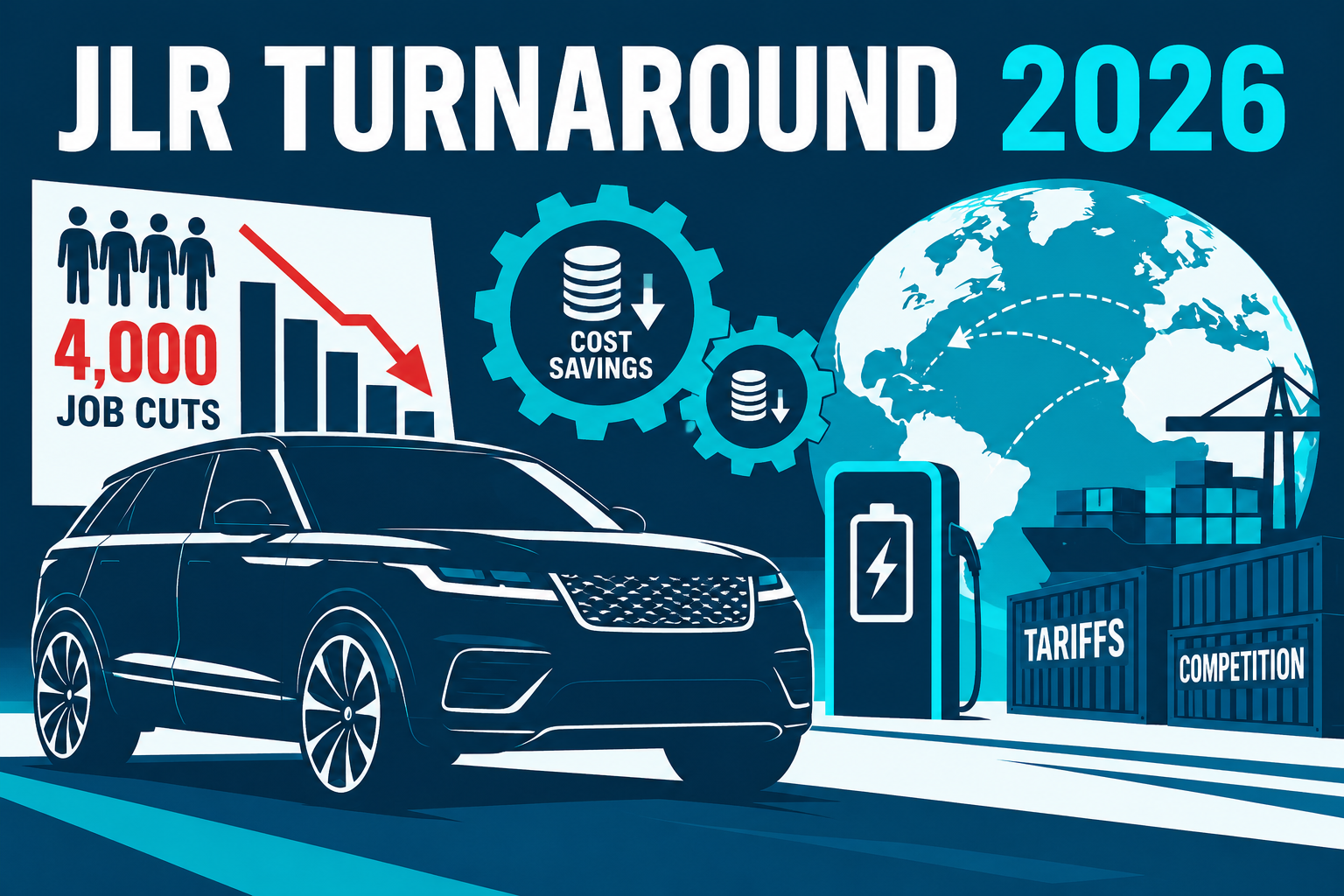
JLR’s 4,000 job cuts show how quickly global companies are being forced to balance cost reduction with investment in future technology. Jaguar Land Rover plans to reduce its worldwide workforce by around 4,000 roles over two years as part of a turnaround designed to save £1.7 billion.
Thank you for reading this post, don't forget to subscribe!The automaker is responding to intense competition, geopolitical uncertainty, tariffs and the continuing effects of a major cyberattack. At the same time, JLR says it intends to keep investing heavily in electrification, digital technology, advanced manufacturing and customer experience.
What JLR Announced
Reuters reported that JLR plans to cut close to 10% of its global workforce, primarily through voluntary redundancies affecting salaried and management roles. The company employs roughly 43,000 people worldwide, with most of its workforce in Britain.
The plan targets a lower break-even point and a simpler organisation. JLR also plans to introduce five products in the next year and invest approximately £15–18 billion over five years in future capabilities.
Why the Automotive Industry Is Under Pressure
Global competition
Established manufacturers face growing pressure from Chinese electric-vehicle companies offering competitive technology and pricing. Traditional brands must modernise without weakening the premium customer experience that supports their margins.
Tariffs and geopolitical uncertainty
Changes in trade policy can affect the cost and location of manufacturing. A company producing vehicles in one country and selling globally must plan for currency risk, tariffs and changing market access.
Cybersecurity disruption
A cyberattack in 2025 interrupted JLR production. The event demonstrates that cybersecurity is not only an IT expense: it is an operational, financial and supply-chain risk.
Expensive technology transitions
Electrification and software require large investment before new products generate returns. Businesses must finance the future while protecting current cash flow.
Five Business Lessons From the JLR Turnaround
- Reduce complexity before cutting capability. Removing duplicated processes can protect customer-facing and innovation work.
- Continue investing during restructuring. Cost reduction without a growth plan can leave a company smaller but not stronger.
- Treat cybersecurity as business continuity. Recovery plans, supplier controls and tested backups protect revenue.
- Measure the break-even point. Leaders need to know the sales level required to cover fixed costs.
- Communicate the strategy clearly. Employees and customers need to understand what changes and what the organisation is building toward.
What Small Businesses Can Learn
Small companies face the same strategic tension at a different scale. When revenue slows, owners may cut marketing, training and technology immediately. That can preserve cash temporarily but damage future demand.
A better approach is to separate waste from capability. Cancel unused software, simplify low-value processes and negotiate supplier costs before removing activities that create sales, protect customers or improve delivery.
A Practical Turnaround Checklist
- Calculate monthly break-even revenue.
- Identify products and customers with healthy margins.
- Remove duplicated tools and approvals.
- Protect the strongest sales channels.
- Review cybersecurity and recovery arrangements.
- Choose a small number of future investments.
- Set measurable milestones for the next 90 days.
- Communicate changes honestly to employees and partners.
Job Cuts Are Not the Whole Strategy
Headcount reduction may lower costs, but execution determines whether a turnaround succeeds. JLR must still launch competitive vehicles, manage global supply chains, rebuild resilience after disruption and persuade customers to choose its products.
My assessment: the most important part of the plan is not the number of roles removed. It is whether the savings create a more focused company capable of delivering its planned technology and product investments.
Final Takeaway
JLR’s 4,000 job cuts reflect the difficult choices facing global manufacturers during technological change. The wider lesson is clear: a credible turnaround must connect lower costs to stronger operations, resilient security and a specific growth plan.
For a small-business version of this approach, read our small business growth strategy and cybersecurity defense plan.
Editorial note: This article summarises reported company plans and provides general business analysis. Workforce numbers and investment plans may change as restructuring progresses.