
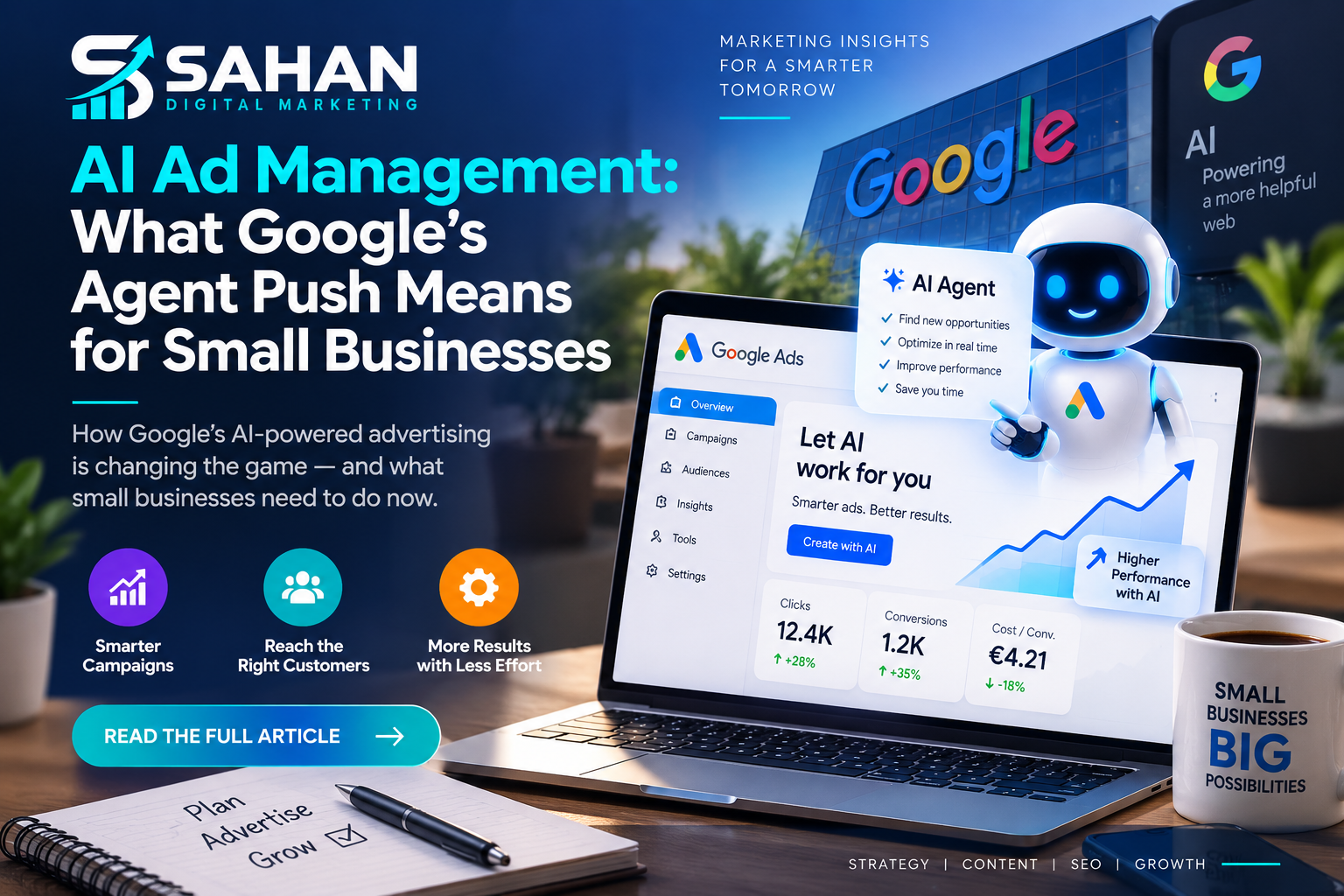
AI ad management is moving from a collection of optional tools to a new operating model for digital advertising. Google’s introduction of Ask Ad Manager—an agent designed to troubleshoot issues, generate reports and guide users through settings- shows where advertising platforms are heading. For small businesses, the opportunity is not simply to automate more work. It is to make faster decisions while keeping strategy, data quality and brand judgment firmly under human control.
This guide explains what the shift means, what to automate first and how to avoid letting a platform optimise for activity instead of profitable growth.
What is changing in AI ad management?
Traditional ad automation followed rules: adjust a bid, pause a keyword or send a report when a threshold was reached. The newer generation of tools can interpret a question, examine account data and recommend or perform a sequence of actions. In its official announcement, Google described Ask Ad Manager as a conversational agent for troubleshooting and custom performance reporting. That is a meaningful change because analysis and navigation- not only bidding- are becoming automated.
For an owner or lean marketing team, AI ad management could reduce hours spent assembling spreadsheets. However, an agent can only reason from the goals, tracking and account structure it receives. A poorly defined conversion remains a poor conversion, even when an advanced model optimises it efficiently.
Start with a business outcome, not a platform metric
Before enabling more automation, write down the commercial outcome of each campaign. “Generate leads” is too broad. A stronger goal is “generate qualified consultation requests at a cost that allows a 30% gross margin after sales costs.” Connect that outcome to a measurable event in your analytics and CRM.
This discipline prevents a common failure: optimising for cheap form submissions that never become customers. It also complements a clear break-even analysis. When you know your allowable acquisition cost, the system has a real boundary rather than an arbitrary target.
A practical five-layer setup
1. Fix conversion tracking
Audit every conversion action. Separate primary events, such as completed purchases or qualified appointments, from secondary events such as page views and button clicks. Test the path on mobile and desktop. If offline sales matter, import the outcome so the platform learns which enquiries create revenue.
2. Protect first-party data
Document which customer data enters the advertising platform, why it is needed and how consent is obtained. Give staff the minimum access required. AI features can accelerate analysis, but they do not remove your privacy responsibilities. Avoid pasting sensitive customer details into open prompts or unapproved tools.
3. Create decision-ready campaigns
Use clear campaign names, consistent conversion definitions and tightly related landing pages. A well-organised account gives AI ad management better context. If campaigns mix unrelated products, locations and margins, automated recommendations will be harder to evaluate.
4. Set human approval boundaries
Decide which actions can run automatically and which require review. Reporting, anomaly detection and draft suggestions are lower-risk starting points. Budget increases, geographic expansion, brand claims and changes to conversion definitions deserve human approval. Record the owner for each decision.
5. Review profit, not just clicks
Hold a weekly review that compares spend, qualified leads, sales, revenue and gross profit. Look for changes in lead quality, not only cost per conversion. A useful dashboard should expose the full path from impression to customer, similar to the approach in our guide to a small-business decision dashboard.
What should small businesses automate first?
The best first uses are repetitive and reversible. Ask an agent to summarise performance changes, identify campaigns with unusual spend, draft a report for stakeholders or explain where a setting lives. These tasks save time without handing over high-impact decisions.
Next, test recommendation workflows in a controlled campaign with a capped budget. Compare the agent’s suggestion with your own analysis. Record the expected result before applying it, then check the actual outcome. This creates an evidence base for expanding AI ad management rather than trusting novelty.
Three risks to watch
- Metric substitution: the system improves the easiest measurable event instead of the result that matters.
- Automation bias: teams accept a recommendation because it sounds confident or comes from the platform.
- Account drift: frequent small changes make the original strategy difficult to recognise and diagnose.
Counter these risks with a change log, a stable test period and a rule that every major adjustment must state the hypothesis, owner and success measure.
A 30-day implementation plan
During week one, audit conversions, permissions and privacy. In week two, define targets based on margins and customer value. During week three, use AI for reporting and anomaly detection only. In week four, run one controlled optimisation test and review both lead quality and profit.
Keep the experiment small enough to reverse. If results improve, expand one workflow at a time. If results weaken, restore the previous settings and inspect the assumptions. This measured process makes AI ad management a capability rather than a gamble.
Frequently asked questions
Will AI ad management replace a marketing specialist?
No. It can reduce manual analysis and surface patterns, but a specialist is still needed to choose positioning, evaluate customer quality, set financial constraints and protect the brand.
Is AI ad management suitable for a small budget?
Yes, but limited data makes careful testing more important. Start with reporting and diagnosis, then allow automated actions only when conversions are reliable, and budgets are capped.
Which metric matters most?
Use contribution profit or customer acquisition cost connected to real sales. Platform conversion counts are useful only when they represent valuable business outcomes.
The bottom line
AI ad management can give small teams faster analysis and more consistent monitoring. The advantage will go to businesses that combine automation with clean data, clear economics and explicit approval rules. Let the agent handle the repetitive work; keep accountability, positioning and investment decisions human.