
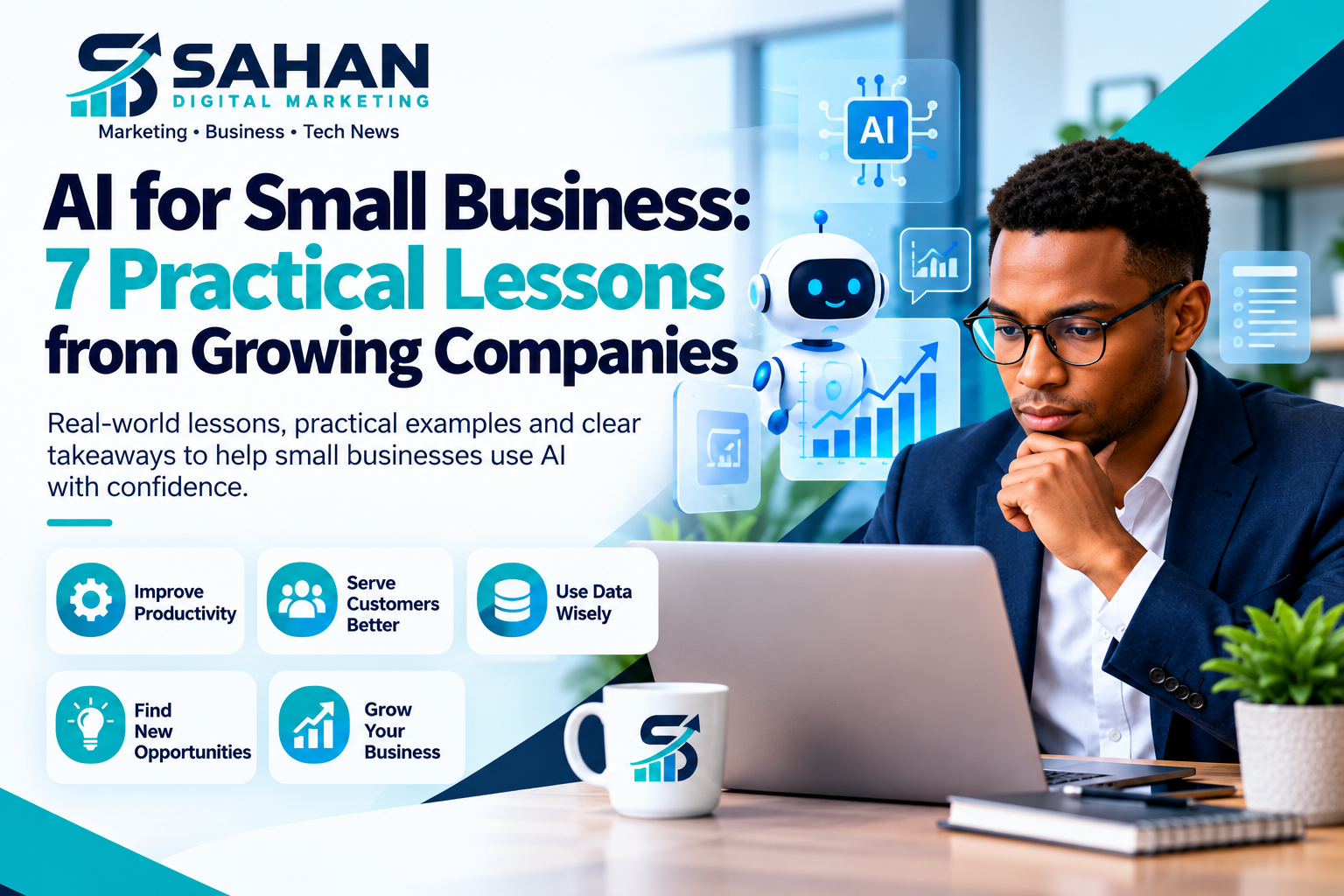
AI for small businesses is becoming less of an experiment and more of an everyday operating tool for growing companies. Google Cloud recently highlighted nearly 20 midsize businesses in Latin America using AI to reduce repetitive work, improve customer experiences, analyse data and support growth. The examples are useful for smaller companies because the lesson is not “use AI everywhere.” It is to match the right AI capability to a specific business problem.
This guide turns those real-world examples into seven practical lessons small businesses can apply without enterprise-sized teams or budgets.
1. Start with one repetitive task
The strongest AI projects usually begin with a clear workflow rather than a vague goal to “use AI.” Look for work that happens frequently, follows a recognisable pattern and consumes staff time: summarising documents, organising customer requests, drafting first-pass content, categorising information or preparing routine reports.
Choose one task, document the current process and measure how long it takes before introducing AI. That gives you a baseline for deciding whether the new workflow actually saves time.
2. Match the model to the job and budget
Google Cloud notes that growing businesses are increasingly choosing different AI capabilities for different tasks. A fast, lower-cost model may be enough for routine summarisation, while complex analysis may justify a more capable model.
For a small business, this is an important cost-control principle. Do not automatically use the most advanced option for every workflow. Define the accuracy, speed, privacy and reasoning requirements first, then select the least expensive capability that reliably meets them.
3. Use AI to make business data easier to understand
One of the most valuable applications is helping non-specialists work with data. AI can assist teams in summarising reports, identifying patterns, translating technical findings into plain language and preparing questions for deeper analysis.
This should complement, not replace, your core measurement system. A useful starting point is a simple small-business decision dashboard that tracks a few metrics tied directly to revenue, customers and operations.
4. Speed up marketing production without removing review
Growing businesses are also using AI to accelerate marketing collateral and content workflows. Small companies can use the same principle for outlines, campaign variations, product descriptions, research summaries and first drafts.
The important control is human review. Brand claims, prices, product details, statistics and customer-facing advice should be checked before publication. AI can shorten the production cycle, but accountability still belongs to the business.
5. Build small agents around well-defined processes
AI agents can be useful when they have a narrow job, clear access boundaries and a defined stopping point. Instead of asking an agent to “run the business,” consider a contained workflow such as collecting information for a weekly report, classifying inbound requests or preparing a draft follow-up for staff approval.
Businesses experimenting with agents should also establish security controls. Our AI agent security checklist covers permissions, data access, logging and human approval points that help reduce unnecessary risk.
6. Measure business outcomes, not AI activity
The number of prompts, generated documents or automated steps is not a business result. Better measures include hours saved, response time, conversion rate, error rate, customer satisfaction, cost per completed task and revenue influenced.
Before launching an AI workflow, choose one or two outcomes that matter. Review them after a few weeks. If the process is faster but requires extensive correction, the apparent productivity gain may be misleading.
7. Scale only after the first workflow proves useful
A successful pilot creates evidence for the next investment. Once one workflow is stable, document the process, permissions, review steps, costs and expected output. Then decide whether the pattern can be reused elsewhere.
This gradual approach is especially useful for small businesses because it limits financial and operational risk. It also makes it easier to identify where automation genuinely helps and where a person still provides more value.
A practical 30-day AI for small business adoption plan
Week 1: identify one repetitive task and record its current time, cost and error rate. Week 2: test an AI-assisted version with non-sensitive data and human review. Week 3: compare the results with your baseline and tighten instructions, permissions and quality checks. Week 4: decide whether to keep, modify or stop the workflow. If it works, document it before expanding.
What small businesses should avoid
Avoid connecting AI tools to sensitive systems before understanding their permissions and data handling. Do not publish generated claims without verification. Do not automate a broken process simply because automation is available. And do not judge success by novelty—judge it by whether the workflow improves a measurable business outcome.
Final takeaway
The most useful lesson from growing companies adopting AI is disciplined experimentation. Start with a real problem, choose an appropriate tool, keep people responsible for important decisions and measure the outcome. Small businesses do not need to copy enterprise AI programs; they need a few reliable workflows that save time or improve customer value.
Sources
Primary source: Google Cloud — How growing Latin American midsize businesses are building in the AI era (September 24, 2026).